Deck: Aziza Kadyri’s Sender Unknown makes the route from collection to dataset, hand and audience newly visible.
At the V&A, a pattern refuses to become a prompt.
That is the quiet force of Aziza Kadyri’s *Sender Unknown*, now in The Jameel Gallery. The work responds to the museum’s historic suzani collection, but it does not ask us to admire the old textile from a safe distance and then marvel at what a machine might make of it. It asks a more exacting question: when a cultural form moves between people, systems and surfaces, what must remain visible for that movement to count as interpretation rather than extraction?[1]
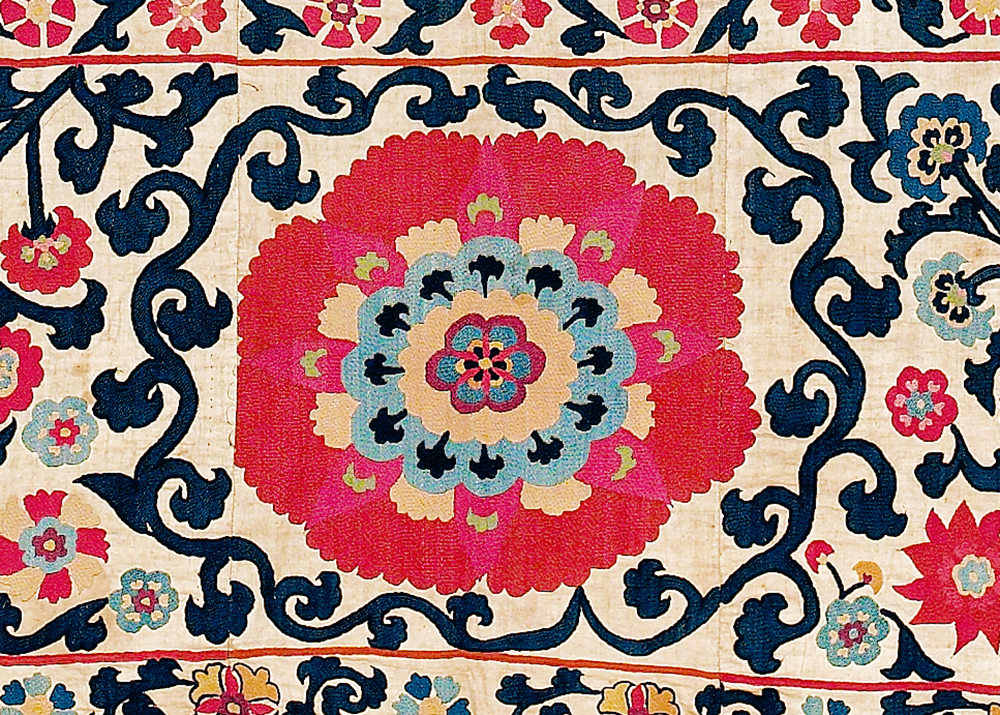
The commission begins with suzani: richly hand-embroidered textiles made across Central Asia, particularly in Uzbekistan and Tajikistan, and traditionally associated with a bride’s dowry. The V&A is clear about the stakes. These embroideries carry women’s labour, migration and intergenerational knowledge; when their images enter datasets, authorship can disappear and history can collapse into pattern.[1]
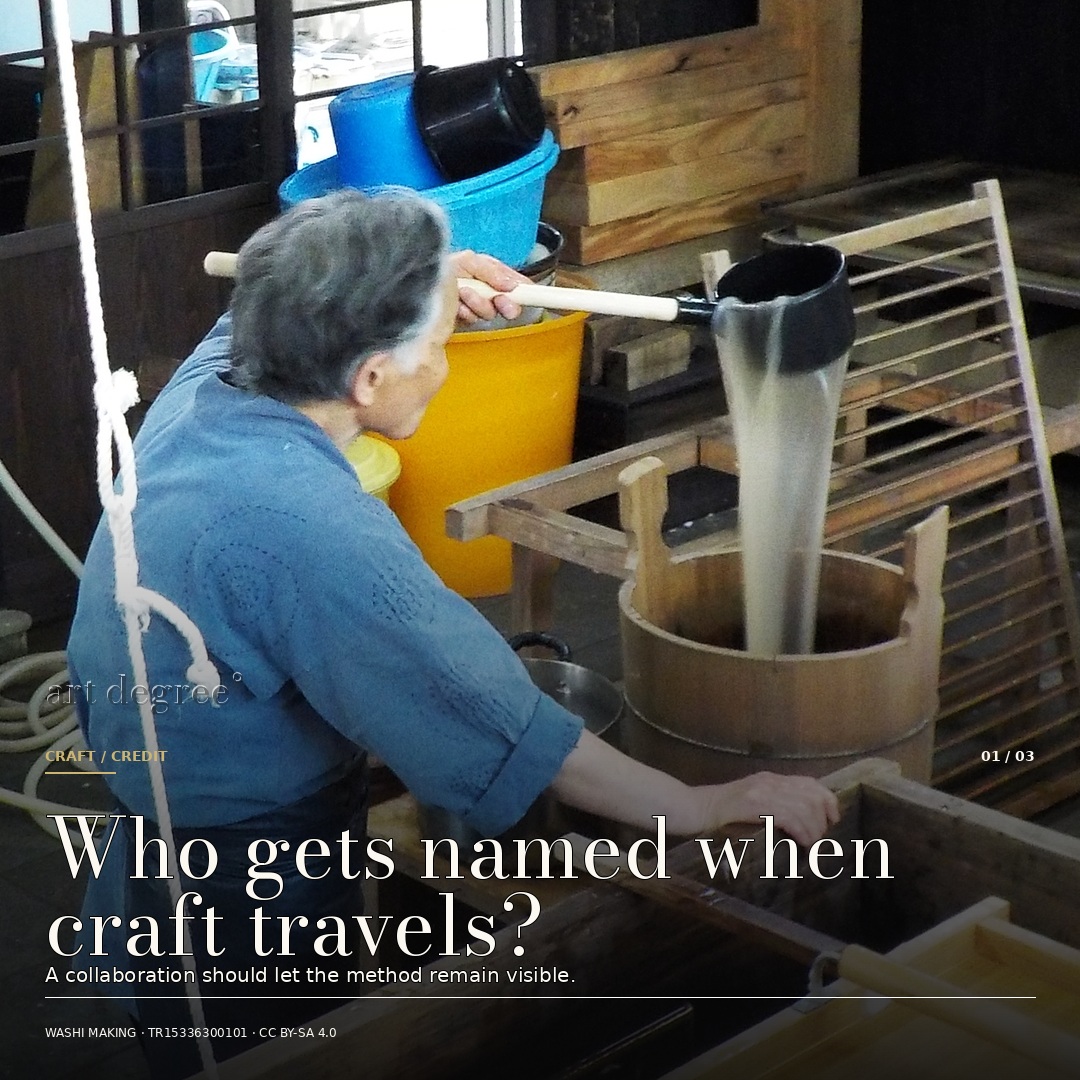
But Sender Unknown does not leave the problem there. Kadyri moves between embroidery and digital textile printing, using a bespoke AI model to develop contemporary symbols. The point is not that the model makes a new suzani. The point is that the work keeps the translation visible. Yulduz Mukhiddinova is named as embroidery master. Women artisans in Nurota, Uzbekistan, hand-embroidered the contemporary motifs. Kacper Reicher is named for digital development. The work is not a smooth machine story with craft added as atmospheric proof. It is a chain of distinct acts, each of which changes what the next one can mean.[1] [2]
That distinction gives the commission a life beyond the current rush to describe everything as “AI and culture”. A pattern is never only a visual unit. It holds decisions about use, occasion, trade, kinship and technique. Digital tools can help an image travel or open new forms of interpretation. They cannot make the conditions of that image irrelevant.
The question is not whether a cultural form can travel. It is whether the people and methods that made it meaningful are allowed to travel with it.
The Translation Trace
The useful thing about Sender Unknown is that it offers a way of looking—not a universal technical standard, and not a claim that every collaboration is equivalent. The following four questions form a small reader tool for approaching any work that brings heritage, technology and contemporary design into contact.
1. Name
Who is identified? Not only the institution or the contemporary author, but the makers, communities, places and material traditions whose knowledge enters the work. A credit line cannot repair every imbalance, but anonymity should never be treated as neutral. Kadyri’s project page names Mukhiddinova, the embroiderers and the digital developer; that level of acknowledgement changes the reader’s understanding of where the work resides.[2]
2. Method
What actually happened between source and result? “Inspired by” is not a method. In this commission, historic suzani does not simply become a dataset and then a visual output. The V&A and Community Jameel describe a bespoke model, newly developed symbols, digital textile printing and embroidery. Community Jameel adds an important limit: the installation does not reproduce historic suzani designs. It develops contemporary motifs in dialogue with a living tradition.[1] [3]
3. Hand
Who interprets the work once the system has generated a possibility? This matters because handwork is too often used as a sentimental finishing touch after the consequential decisions have already been made elsewhere. In Sender Unknown, the Nurota artisans do not decorate a completed digital claim. Their embroidery is one of the ways the commission becomes a work at all. The V&A’s linked workshops, led by Mukhiddinova, extend that distinction into public space: technique, motif and historical context are part of what visitors are invited to encounter.[3]
4. Return
What returns to the living field from which the reference came? This is the hardest question, and the one an exhibition label cannot answer by itself. Return can mean visible credit, paid collaboration, training, access, continuation, shared authority or a durable connection to practice. The sources available here establish named collaboration and public workshops; they do not licence the writer to claim the wider question has been solved. The point is to keep asking it.
Not every archive needs to become raw material
Museums have long been places where objects are preserved, classified and made newly legible. That work can be generous. It can also create a dangerous illusion: that to be catalogued is to be fully known. Datasets intensify the illusion because they make the image feel detachable from the person, place and relation that gave it weight.
Kadyri’s commission offers no easy purity. Suzani itself has evolved through exchange; Central Asian textile traditions are not frozen forms waiting to be protected from the present. But exchange and extraction are not the same action. The difference lies in whether the translation has traceable authorship, intelligible methods and living participants—or whether it disappears into a frictionless visual supply.
That is why Sender Unknown is stronger than a cautionary tale about machines. It puts craft and computation in a room together and makes their unevenness visible. The resulting object asks more of the viewer than technological awe. It asks for attention to the route.
The Translation Trace is the part worth keeping. Before calling a cultural reference innovative, ask what was named, how it changed, whose hand carried it forward and what returns to the people whose knowledge made the reference possible.
Visit and continue reading
Sender Unknown is free to visit in Islamic Middle East, Room 42, The Jameel Gallery at V&A South Kensington from 15 September 2026 until 9 January 2027. The most useful next step is to read the commission alongside Kadyri’s own project credits and Community Jameel’s account of the workshops—not only to see an image, but to follow the people and methods around it.[1] [2] [3]
Sources
[1] V&A — Aziza Kadyri: Sender Unknown