Silk is a quotidian object before it is a luxury. For West Africa, where the most complex textile traditions developed, weaving is associated with the women of the compound. A daily practice, it becomes an example for politics and resistance. On market days in Kano, weavers were told to read the cloth as a language. If, when morning came, the pattern held its geometry, they had been gifted with the art of speaking without words. Of the Yoruba proverb, it is said: 'I will tell you the essence of a person's character: it is all in how they wear their cloth.'
It is in the traditions of West African dress that silk meets its most radical fortunes. The aso-oke of the Yoruba — hand-woven strips of cotton and silk, assembled into garments of extraordinary complexity — is a fabric that speaks to ceremony, to status, to the refusal of invisibility. The kente of the Akan, woven in Bonwire on narrow looms, carries in its geometry an entire cosmology: each pattern a proverb, each colour a political statement. Gold for royalty. Black for maturation. Green for growth and renewal.
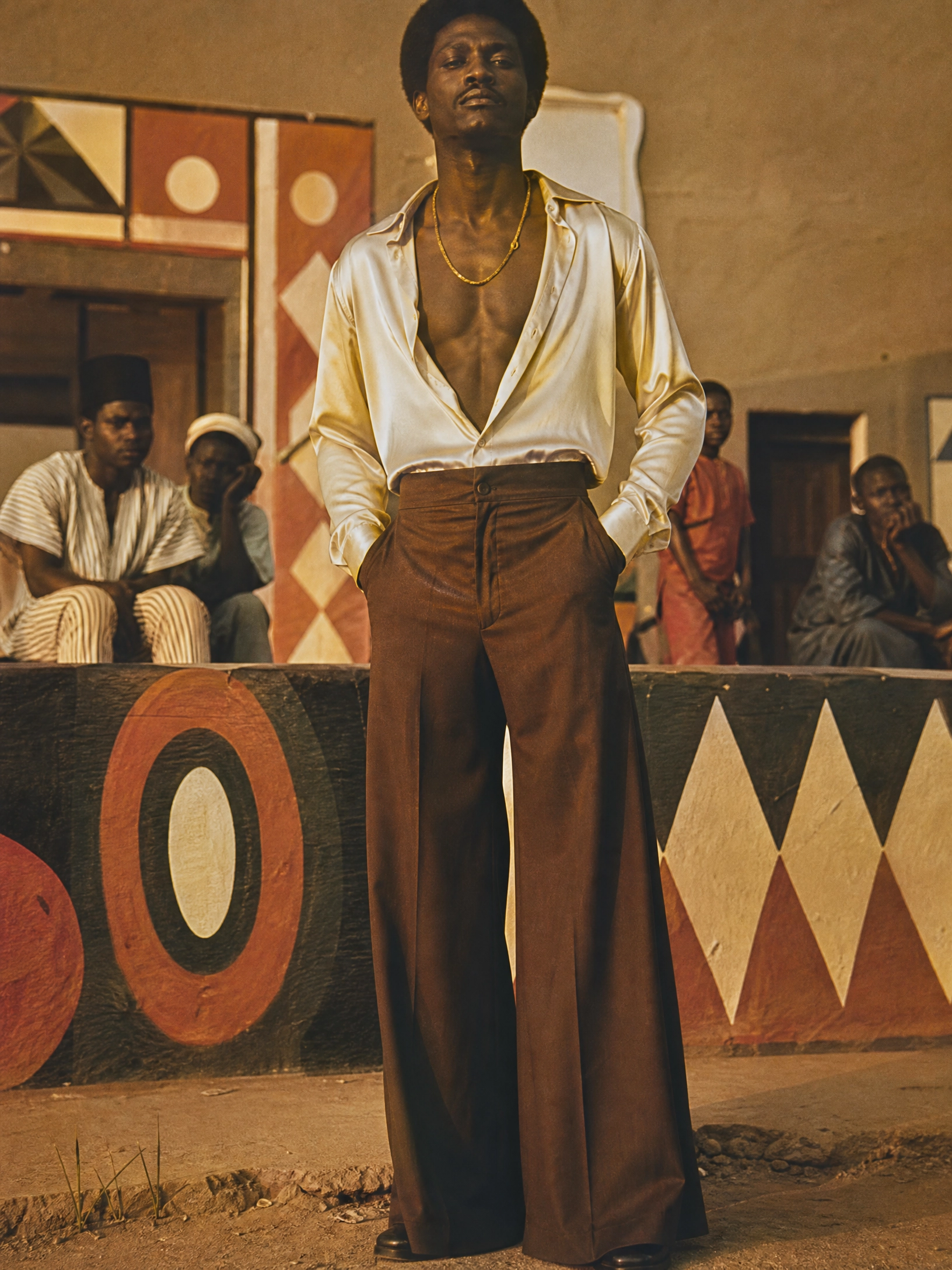
It is in this tradition — the tradition of cloth as argument — that Fela Anikulapo-Kuti must be understood. Not as an eccentric, not as a provocateur, but as a man who had studied the semiotics of dress with the same rigour he brought to music theory. A cold fabric, Fela often wore it against the heat of Lagos, the silk shirt open to the chest, the trousers loose, the body itself a statement of sovereignty. It interrupted the seriousness of the political moment, and marked the sensuousness of the resistance. As a stage costume, a political uniform, a daily skin, silk was Fela's liquid manifesto.
The butterfly bombyx mori yields the most desirable silk. With its triangular profile, its fibres reflect light the best. Fed on mulberry leaves, larvae produce a long string which they wrap around themselves during chrysalis. There is something in this — the transformation from larva to flight — that Fela understood instinctively. The Shrine, his Lagos nightclub and commune, was a chrysalis. What emerged, night after night, was something that could not be contained.
West Africa's own silk traditions predate European contact. The Yoruba had been weaving sanyan — a wild silk produced by the anaphe moth — for centuries before the Portuguese arrived. A cream-coloured, slightly rough fabric, sanyan was the prestige cloth of chiefs and priests. When Fela appeared on stage in the 1970s in a silk shirt — often open, always deliberate — he was not borrowing from European glamour. He was reclaiming a lineage.
The silk filament's fibre is extremely fine and extremely long: 1,200 metres at its longest. It is to prevent larvae from breaking their cocoons by emerging from them that silk farmers suffocate them. The cocoons are then washed, dried, wrapped and woven into long threads. Fela knew this story. He called his music 'the weapon of the future.' The silk shirt was the weapon's sheath.
It is with the 20th century that the silk shirt returns to its first use — as political skin. During the Biafran War, Nigeria lost access to many imported materials. What remained was what had always been there: the indigenous textile traditions, the hand-woven cloth, the body as the only territory that could not be colonised. Fela's silk shirts — often made by local Lagos tailors, cut to his specifications, worn open to the waist — were a declaration of this sovereignty.
In the 1970s, his stage costumes became increasingly minimal. The shirts opened further. The trousers tightened. The body itself became the argument. Bowie, on the other side of the world, was doing something similar — but Bowie was borrowing. Fela was originating. In Lagos, in Accra, in Abidjan, young men found silk shirts in the markets and wore them to clubs, to protests, to funerals. Oddly resistant, the fabric dressed an entire generation of West African men in a politics of visibility. Worn under a traditional agbada, the silk shirt undressed its owner's ambitions.
'Music is the weapon,' Fela said. But the shirt was the flag.