Deck: Paris Fashion Week’s current calendar makes a quiet fact plain: a collection is already a different cultural object in a room, a livestream, a digital presentation or a film released later.
Fashion week is usually narrated through the first image.
A model turns. A front row reacts. A look enters circulation before the room has emptied. The photograph appears to be the record.
But the photograph is only one answer to a prior question: what form has this event been given, and what form will remain after the lights change?
Paris Fashion Week’s current official calendar is unusually useful because it says the quiet part out loud. It does not simply list a house, an hour and an address. It distinguishes a Show Physique by invitation from a Show Livestream, a Presentation Digital from a Film of the show revealed later.
On 5 October, Sacai appears as a physical show with a simultaneous livestream. Ungaro appears as a physical presentation with a digital presentation. Agnes b. appears as a physical show with a film revealed later. The next day, Ujoh, Litkovska, Christopher Esber and CFCL are listed as physical shows with a digital version. These are small labels in a long schedule, but they identify different cultural objects.
A room is not a stream. A stream is not a later film. A digital presentation is not a room at a distance.
Each version edits the encounter differently. The room has duration, seating, sound, weather, waiting and the particular social arrangement that made attendance possible. A livestream offers simultaneity to a dispersed audience, but selects an angle and a rhythm. A digital presentation may be built for the screen from the outset. A film revealed later may turn the show into a second work, with its own pace and point of view.
None is automatically more democratic, more truthful or more lasting. A stream can disappear. A room can be documented with extraordinary care. A later film can make something previously unavailable legible to a reader elsewhere. The point is not to rank them. It is to stop calling them the same thing.
This is why the fashion-week calendar matters more than it first appears. It is not merely an invitation ledger. It is an early archive of the forms through which a collection expects to survive.
Tokyo offers another grammar of survival. Japan Fashion Week Organization’s official report on the final day of its 2027 SS season describes KHOKI’s set at Terada Warehouse as a kitchen and bedroom, with roughly half of the props supplied from the homes of its own design team. The starting point was a childhood room in Yamanashi. What is preserved in that organiser’s description is not only a silhouette but an arrangement of memory: domestic objects, a working group and a chosen origin for the set.
The same report documents the Fashion Prize of Tokyo ceremony as an installation, a performance by Shing02 and a runway with 16 models. It describes soduk’s closing show through the designer’s Okinawan reference, a soundtrack, collaborators, flowers, room-like partitions and a deliberately slow movement through the space. Again, this is not a claim that every Tokyo presentation works this way. It is a reminder that a fashion-week record may be a performance score, an award mechanism, a set of collaborators and a local relation, as much as a runway image.
Shanghai offers a third scale. Its official municipal announcement for SS27 describes a season opening on 8 October under the theme “Renewed Radiance”, with nearly 100 runway presentations, around 1,000 participating brands, trade fairs, industry dialogues and citywide consumer experiences. It names HEMU’s fifteenth appearance and the collection’s engagement with yunjin and song brocade, kesi tapestry and embroidery.
This is an official city account rather than a neutral review, and should be read as such. Still, it makes a useful distinction visible. Here the week is not described only as a sequence of houses. It is a civic and industrial programme with several ways of becoming visible: presentation, commerce, heritage reference, dialogue and urban encounter.
Together these cases ask us to replace a simple question—did you see the show?—with a better one: what record of the show are you looking at?
Use a Format Ledger:
- ROOM: What happened in person, and what conditions produced that encounter?
- CAPTURE: How was it mediated—livestream, digital presentation, later film or organiser report?
- RECORD: Who names the format, date and context?
- AFTERLIFE: What can a reader actually return to, and what has already been lost to the moment?
The ledger is not a consumer guide and it does not turn fashion into an audit. It is a way of noticing where cultural memory is made. A collection is not only what walked past the audience. It is also the chosen relation between live event, institutional description, camera and later return.
The show is already an archive. The useful work is to read which archive it has become.
Official sources: FHCM — Paris Fashion Week SS27 official calendar · Japan Fashion Week Organization — 2027 SS 5 September report · Shanghai Municipal Government — Shanghai Fashion Week SS27 schedule.
Image context
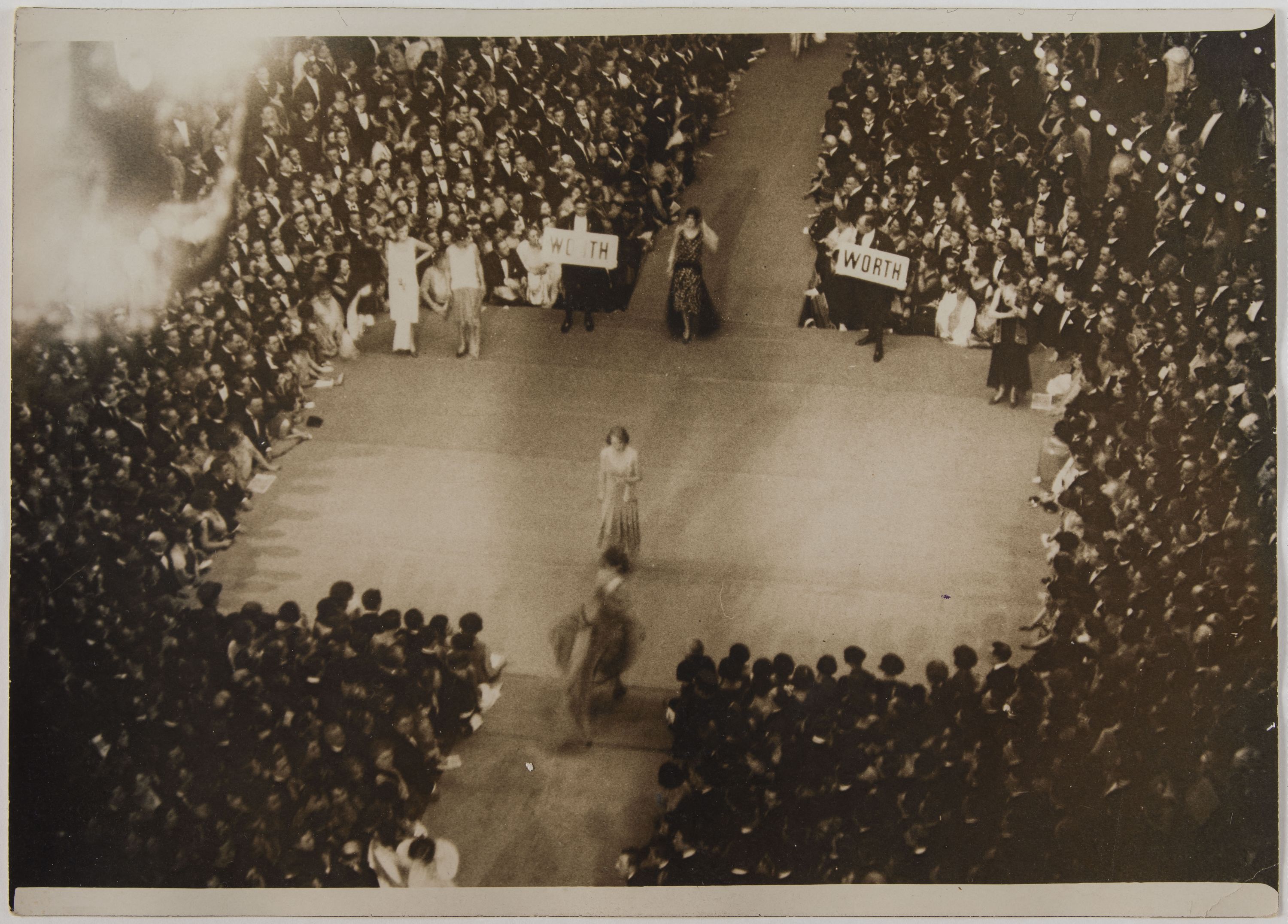
The lead photograph is a 1929 Paris fashion-show document, not Paris Fashion Week SS27 or a photograph of any current house. It was made by Agence Rol and is released CC0.