Venice Biennale: Foreigners Everywhere
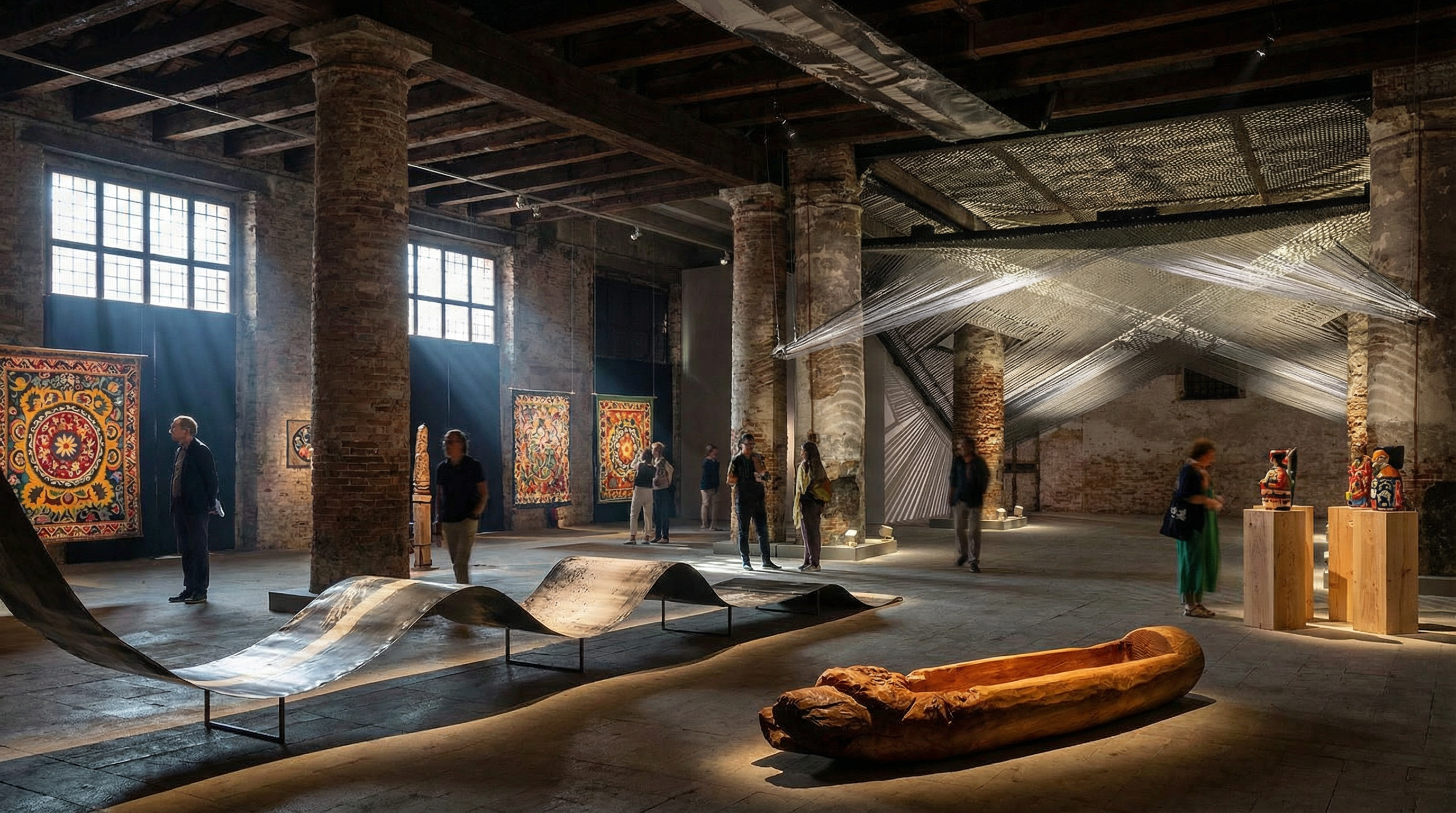
The 60th Venice Biennale, curated by Adriano Pedrosa under the title **"Foreigners Everywhere,"** was the year's most politically charged and aesthetically ambitious exhibition. Pedrosa, the first Latin American curator to helm the Biennale, centered the entire enterprise on artists from the Global South, Indigenous communities, and what he termed "outsider" practices—those historically excluded from the Western canon.
The title itself, borrowed from a collective of queer artists in Palermo, functioned as both provocation and invitation. In a year marked by rising xenophobia and border militarization across Europe and North America, the Biennale insisted on the migrant, the refugee, the foreigner as the defining figure of contemporary life. This was not diversity as window dressing. It was a wholesale reimagining of the Biennale's curatorial logic, one that placed artists like Nil Yalter (Turkey/France), Cecilia Vicuña (Chile), and Pacita Abad (Philippines) at the center rather than the margins.
The exhibition's most powerful moments came not from the grand pavilions of the Giardini but from the quieter, more intimate spaces of the Arsenale, where Pedrosa showcased textile works, folk art, and Indigenous practices that have long been dismissed as "craft" rather than "art." The effect was disorienting in the best sense—visitors accustomed to the white-cube aesthetics of contemporary art were confronted with objects that demanded different modes of attention, different ways of seeing.
Critics have debated whether the Biennale succeeded in its decolonial ambitions or merely repackaged them for an elite audience. But the more important question is not whether Venice has been decolonized—it is whether the Biennale still matters as much as it once did. In a year when Beijing, Lagos, and Singapore have emerged as equally significant sites of cultural production, Venice's centrality is no longer a given.
MoMA's "Ideas of Africa": Pan-African Portraiture as Political Imagination
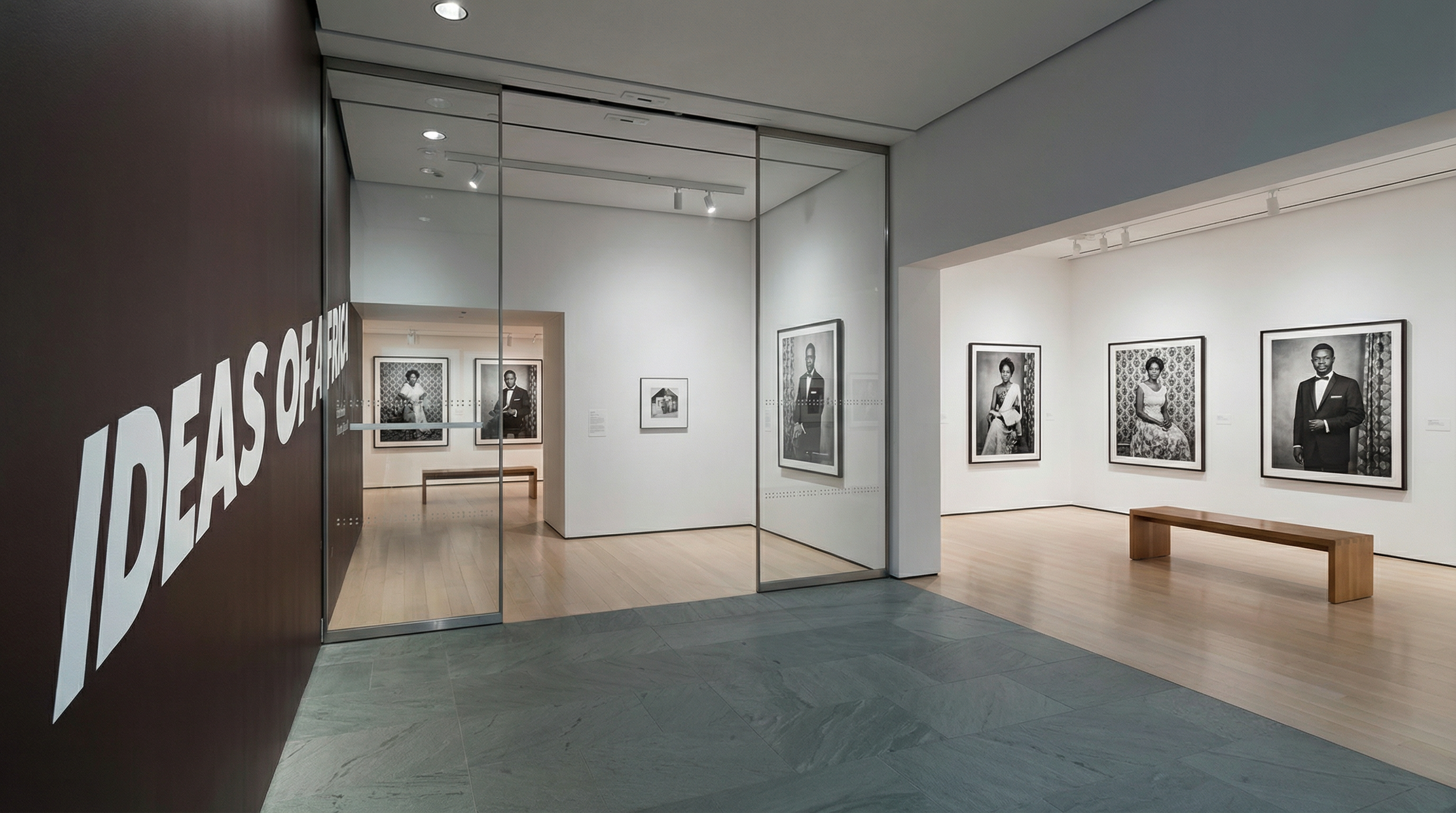
If the Venice Biennale asked what it means to be a foreigner, The Museum of Modern Art's "Ideas of Africa: Portraiture and Political Imagination" (December 14, 2025 – July 25, 2026) asked what it means to imagine a collective identity across continents, languages, and histories. Curated by Oluremi C. Onabanjo, the exhibition brought together photographic portraits from the 1950s to the present, tracing the visual construction of Pan-Africanism as both a political movement and an aesthetic project.
The exhibition's central argument—that portraiture has been a crucial tool for articulating Black subjectivity and solidarity—was not new. But the depth and rigor with which Onabanjo pursued this thesis made the show one of the year's most intellectually compelling. The works on view, drawn largely from Jean Pigozzi's 2019 gift to MoMA, included iconic images by Malick Sidibé, Seydou Keïta, and Sanlé Sory, alongside lesser-known figures like Oumar Ka and Jean Depara.
What made the exhibition revelatory was its insistence on the transatlantic dimension of Pan-Africanism. By placing Malian studio portraits alongside the work of Kwame Brathwaite, whose photographs of Black models in the 1960s helped define the "Black is Beautiful" movement in the United States, Onabanjo showed how ideas of African identity were co-produced across continents. The exhibition's final room, featuring contemporary works by Samuel Fosso and Silvia Rosi, extended this lineage into the present, asking what Pan-Africanism might mean in an era of mass migration, digital networks, and climate crisis.
"Ideas of Africa" arrived at a moment when major American museums are under pressure to diversify their collections and exhibition programs. But unlike many such efforts, which feel tokenistic or reactive, this show was rigorous, historically grounded, and unapologetically political. It did not ask for inclusion in the Western canon—it proposed an alternative canon altogether.
UCCA Beijing: The New Center of Gravity
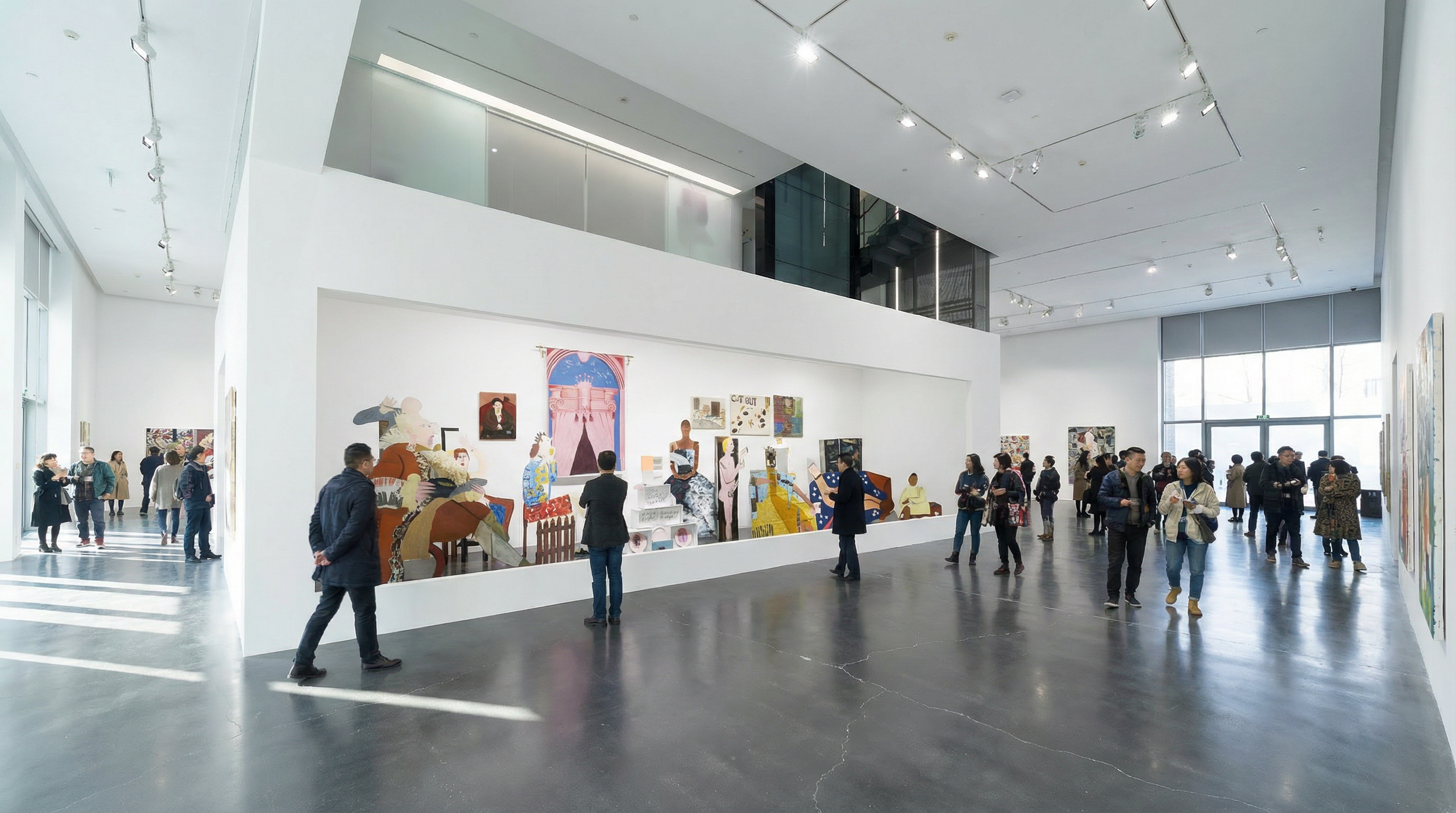
While Western institutions scrambled to catch up with the discourse around decolonization, UCCA Center for Contemporary Art in Beijing quietly assembled one of the most ambitious exhibition programs in the world. The 2025 calendar, featuring nine major shows across UCCA Beijing and UCCA Dune, made a compelling case that Beijing—not New York or London—is now the most important city for contemporary art.
The year's standout was Lubaina Himid's first solo exhibition in China (January 18–March 27, 2025). Himid, a British artist and key figure in the Black Arts Movement of the 1980s, has spent four decades interrogating the erasure of Black subjects from European history. Her paintings and installations—including the monumental A Fashionable Marriage and the Naming the Money series—restage historical scenes to make visible the labor and lives of enslaved Africans. Bringing this work to Beijing, a city with its own complex relationship to colonialism and empire, created unexpected resonances.
Equally significant was Anicka Yi's first major presentation in Asia (March 22–June 15, 2025). Yi, a Korean-American artist known for her immersive, sensory installations, has been exploring what she calls the "biopolitics of the senses"—the ways in which our perceptual experiences are shaped by cultural, biological, and technological forces. The UCCA commission, co-organized with Seoul's Leeum Museum of Art, marked a homecoming of sorts for an artist whose work has been more celebrated in Europe and North America than in Asia.
But perhaps the most symbolically charged exhibition was Chen Ke's "Bauhaus Gal" (May 17–September 7, 2025). Chen, a Chinese painter, has been working with archival photographs from the Bauhaus, filtering images of women from the German school through her own memories and feelings. The exhibition took place at UCCA's Factory 798 location, a space originally designed in the 1950s by a state institute in Dessau, the East German city that was home to the Bauhaus's final iteration. The layering of histories—German modernism, Chinese socialism, contemporary Chinese art—created a kind of feedback loop, a reminder that cultural influence has never been unidirectional.
UCCA's 2025 program also included major shows by Pipilotti Rist, Yang Fudong, Liao Fei, and Koki Tanaka, making it one of the few institutions in the world capable of presenting both Western blue-chip artists and cutting-edge Asian practitioners at the highest level. The message was clear: Beijing is no longer playing catch-up. It is setting the agenda.
M+ Hong Kong: Feminist Futures
Across the border in Hong Kong, M+ Museum opened "Dream Rooms: Environments by Women Artists 1950s–Now" (September 20, 2025 – January 18, 2026), a sweeping survey of immersive installations by women artists over the past seven decades. The exhibition, which included works by Yayoi Kusama, Judy Chicago, Pipilotti Rist, and Cao Fei, argued that women artists have been pioneers of the immersive, participatory art that now dominates biennials and museums worldwide.
The show's title, "Dream Rooms," suggested something private, even domestic—a deliberate provocation in a context where women's labor has historically been confined to the home. But the works on view were anything but domestic. They were ambitious, technically sophisticated, and often explicitly political. Cao Fei's virtual reality environments, for instance, explored the digital lives of Chinese factory workers, while Judy Chicago's iconic The Dinner Party reclaimed women's contributions to Western civilization.
"Dream Rooms" was also a reminder of M+'s unique position as a major contemporary art museum in a city caught between two political systems. The exhibition opened just months after new security laws further restricted freedom of expression in Hong Kong, and while the show itself was not overtly political, its celebration of women's voices and feminist perspectives felt quietly defiant.
Singapore Biennale: Pure Intention
The Singapore Biennale 2025: "pure intention" (October 31, 2025 – March 29, 2026) took a different approach, eschewing grand political statements in favor of what its curators described as "contemplative engagement." The exhibition, spread across multiple venues and public spaces, invited audiences to slow down, to pay attention, to cultivate what the Buddhist tradition calls "right intention."
In a year dominated by urgent political questions—climate crisis, migration, inequality—the Biennale's emphasis on interiority and mindfulness felt almost radical. The works on view, by artists from Southeast Asia and beyond, explored themes of ritual, meditation, and spiritual practice. Apichatpong Weerasethakul's video installations, for instance, invited viewers into dreamlike states of consciousness, while Titarubi's textile works drew on Indigenous weaving traditions to create meditative spaces.
Critics have questioned whether the Biennale's apolitical stance is a form of evasion, a retreat from the messy realities of contemporary life. But in a region where political expression is often constrained, the cultivation of "pure intention" may be its own form of resistance—a refusal to be conscripted into the culture wars, a commitment to preserving spaces of contemplation and care.
What 2025 Revealed
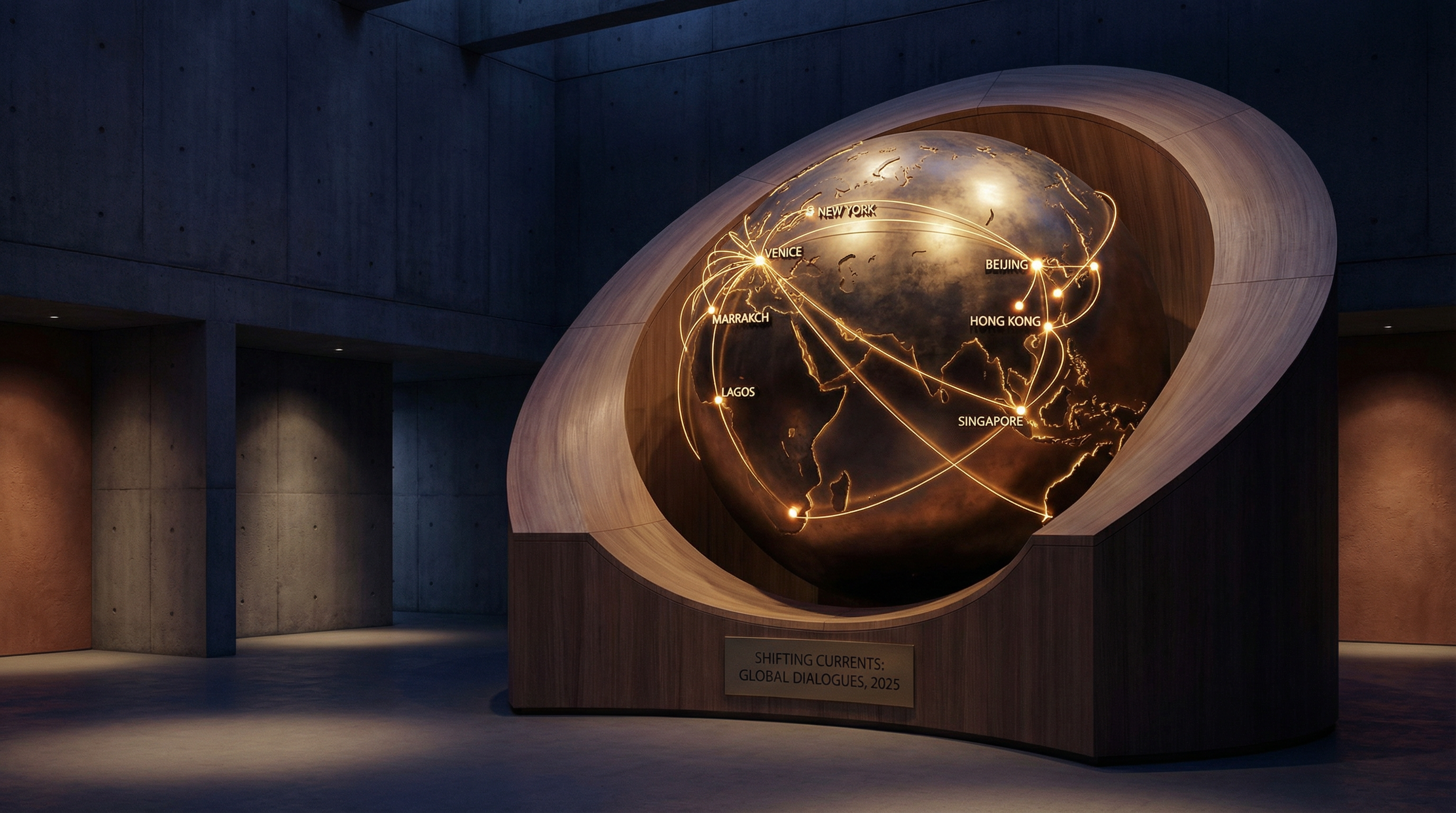
Taken together, these exhibitions and institutions reveal a cultural landscape in flux. The old certainties—that New York and London are the centers of the art world, that Western museums set the agenda, that contemporary art is a universal language—no longer hold. In their place, a more multipolar, more contested, more interesting geography has emerged.
This shift has been accompanied by new questions. What does it mean for a Western institution like MoMA to mount an exhibition about Pan-Africanism? Can a museum built on colonial wealth ever truly decolonize? What happens when the most ambitious contemporary art is being made in cities—Beijing, Lagos, Singapore—that operate under very different political systems than the liberal democracies of Europe and North America?
These are not questions with easy answers. But they are the right questions, and 2025 was the year when they could no longer be avoided. The world has shifted, and the art world is finally catching up.
This article is part of art degree°'s ongoing coverage of global contemporary art. For more on the exhibitions and artists shaping the cultural landscape, explore our Art° and Culture° verticals.