The Surface Is Already a History
Nengi Omuku’s painting asks us to stop treating material as a backdrop to the work.
The language of contemporary painting is often suspiciously clean. We talk about composition, image, gesture, colour, scale. The surface is called a support, as if its best quality were silence.
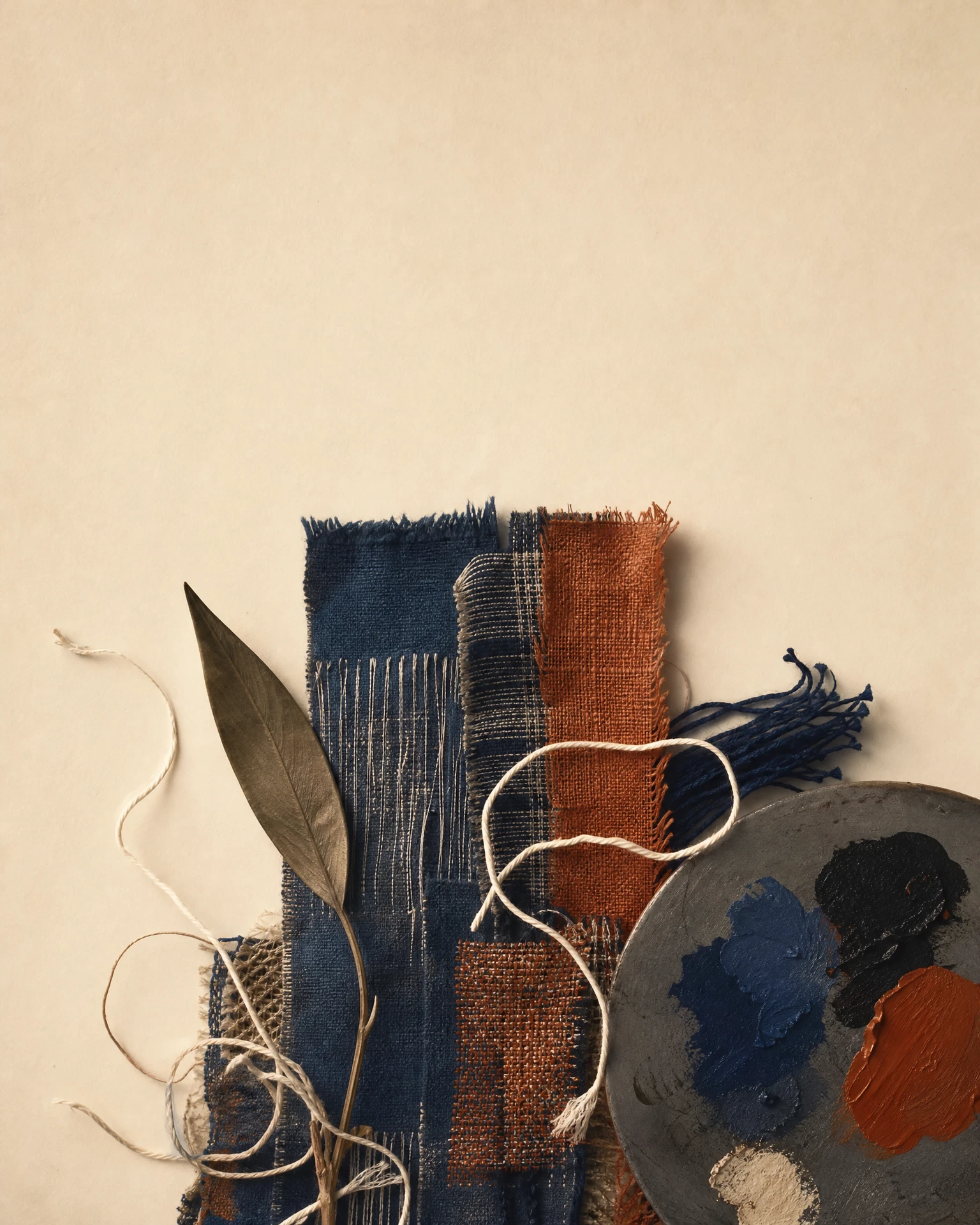
Nengi Omuku’s paintings do not permit that silence. The Nigerian artist works on sanyan, a handwoven Yoruba textile whose history includes ceremony, prestige and skilled production. In her account of her studio process, she takes the textile apart, reverses the stitches, prepares the back and paints on that reverse side.1 The surface is therefore not the neutral beginning of an image. It arrives already carrying a set of relations: fibre, labour, use, memory and transmission.
That is a useful way into The Gathering, Omuku’s first US solo museum exhibition, on view at San Francisco’s de Young from 27 June 2026 to 14 May 2028.2 The museum presents her dreamlike paintings alongside works from its Arts of Africa collection. Its framing is careful: Omuku’s landscapes imagine forms of care and belonging for young Nigerians, while the dialogue across the galleries asks how stories, land and community remain connected.2
There is a weak version of this story. It would call the textile “inspiration,” take a quick photograph of its texture, and return to the familiar hierarchy in which painting is the serious work and cloth is its atmosphere. Omuku’s practice is more demanding. The material changes the terms on which the painting is made.
In a film produced by the Fine Arts Museums of San Francisco, Omuku describes asking why she should import canvas or linen when Nigeria has deep textile histories. She speaks of finding cotton spinners and commissioning the slow work of thread and woven panels for her studio.1 That does not make a painting morally pure; it does make the chain of material decisions visible. The question is no longer simply what is pictured. It is what kind of world has been assembled before the image appears.
This is where the exhibition becomes more than a museum event. Sanyan is often described in relation to heritage, and it is. But heritage is not a fixed visual language waiting to be lifted into contemporary art. In Omuku’s work it behaves more like a live proposition: a material can retain the force of its history while being tested by new scales, oil paint, abstraction and imagined landscapes.
The de Young’s own account describes the paintings as worlds of vegetation, water and gathering, and locates them beside historical sculptures and textiles shaped by ancestry, nature and community.2 That pairing could have been merely illustrative. Instead, it offers a better proposition for contemporary culture: the past is not a theme supplied to the present. It is a set of working materials.
For art degree°, that matters because the most consequential cultural work often turns on what has been mistaken for background. A surface is never only a surface. It can be an archive of technique. It can record which forms of expertise have been treated as domestic, decorative, informal or unavailable to the canon. It can also make another future visible.
This is not an argument that every painting needs to announce its supply chain. Nor is it a request to treat a Yoruba textile as an emblem of authenticity. It is a more exact invitation: look at the support. Ask what knowledge had to exist before the image could exist. Ask which histories a work lets remain active rather than merely cited.
Omuku’s paintings offer no simple answer. They offer something more useful: a surface on which painting, textile, ceremony, ecological fragility and collective imagination meet without being flattened into one another. The canvas, it turns out, may not be blank because it was never only a canvas.
Footnotes
-
Fine Arts Museums of San Francisco, “How Artist Nengi Omuku Paints New Worlds,” 10 July 2026, https://www.famsf.org/learn-engage/read-watch-listen/nengi-omuku-paints-new-worlds — transcript of the artist and curator discussing sanyan and the studio process. ↩ ↩2
-
Fine Arts Museums of San Francisco, “Nengi Omuku: The Gathering,” https://www.famsf.org/exhibitions/nengi-omuku — exhibition dates, curatorial context, and material description. ↩ ↩2 ↩3