A fair concentrates attention with unusual force. A room fills, a work is photographed, a conversation becomes a caption, and a name begins to travel. For a few days, artists, dealers, curators, museum directors, collectors and readers are brought into an unusually dense proximity.
That temporary gathering is not trivial. It can be the beginning of a cultural route.
The question is what happens when the room disappears.
This is not an argument that every work needs a museum or that a public collection is the only measure of artistic importance. Nor is it an instruction to look past the commercial life of art. A fair is a place where work is seen, argued over, bought, loaned, supported and sometimes redirected. Its cultural claim becomes more serious when we can see what it hands forward.
Call this the Handover Test. It has four lines.
Convene: what temporary room has made a meaningful encounter possible? Advocate: who has put their name behind a practice? Custody: which institution has committed to care for a work or record? Access: where might a reader encounter it after the fair’s dates?
The first line, convene, matters because a fair is neither only a marketplace nor automatically a public institution. It is a temporary piece of infrastructure. Its particular strength is that it can put people, objects and institutions within reach of one another at a pace that ordinary museum schedules and private collections cannot always achieve.
TEFAF Maastricht this year gives the mechanism a useful, precise form. TAFETA presented the Nigerian ceramicist Ladi Kwali in its Focus section. TEFAF subsequently stated that the High Museum of Art in Atlanta acquired Kwali’s 1968 Water Pot/Waterpot after that presentation. The work is hand-built stoneware, with incised zoomorphic designs, white-slip inlay and iron and transparent glazes.
The transaction should not be dressed up as a rescue narrative. Kwali does not become important because a US museum acquired her work. Nor was this the High’s first Kwali: the museum already held her 1972 Green water jar. What the 2026 route makes visible is something more practical. A specialist dealer’s concentrated presentation, a museum’s collecting capacity and a fair’s temporary meeting ground have made an additional work available for long-term institutional care and interpretation.
That is a different proposition from the language of “discovery”. It is a route through which a work can enter a collection with a public responsibility: to conserve it, place it in relation to other histories and give future audiences a reason to return.
Frieze London offered another form of convening. In its 2026 Artist-to-Artist section, seven artists were nominated by established artist peers for solo presentations. The published pairings include Jota Mombaça, nominated by Otobong Nkanga, and Unathi Mkonto, nominated by Yinka Shonibare.
This brings us to advocate. A nomination is not a guarantee, and it does not dissolve the uneven conditions around visibility, capital or access. But it makes one relationship legible. An established practitioner says publicly: this work deserves a room. The gesture can be examined, remembered and compared. It is more accountable than the vague language of discovery.
Then comes custody. On 14 October, Frieze reported that the CAS Collections Fund had acquired works by Karimah Ashadu, Gala Porras-Kim and Claudia Alarcón & Silät for the Whitworth Art Gallery in Manchester. Ashadu’s Machine Boys is a 2024 video work about the precarious world of motorcycle-taxi riders in Lagos. Alarcón & Silät’s 2026 textile is made from chaguar fibre within a Wichí women’s collective.
These are not simply fair-floor highlights. The announced acquisition gives the works a stated public-collection afterlife. They can enter a longer conversation about labour, cultural memory, institutional knowledge and collective making, not as generic emblems of internationalism but as particular practices with particular material and social histories.
The same week brought a second, more compact example. The inaugural Dasha Shenkman Focus Fund acquired a painting, lightbox work and preparatory drawing by London artist Okiki Akinfe for Abbot Hall in Kendal. “Supporting emerging artists” can mean almost anything. A named fund, named works and a named public collection mean something that can be checked years later.
The last line is access. A public collection is not the same as a ticketed fair. Frieze London and Frieze Masters ran from 14 to 18 October, with invitation-only and member-preview windows before general admission. That is not a criticism; it is a description of the terms. The point is to avoid collapsing different forms of cultural encounter into one flattering word: public.
A fair ticket opens a temporary commercial room. A peer nomination makes advocacy visible. An acquisition can create a later public encounter. Each is valuable in a different way. Each requires different questions.
The Handover Test keeps the language clean:
- Convene: what encounter did the fair make possible?
- Advocate: who put their name behind the work?
- Custody: which institution has committed to holding it?
- Access: where can a reader meet it after the fair closes?
This is not a scorecard for who is deserving. It is a way of seeing an event beyond its most photogenic moment. London matters because it remains a meeting point where these routes can begin. TEFAF matters because it shows how a specialist presentation can meet museum stewardship. Neither fair becomes culturally consequential simply by gathering important people. The consequence lies in whether the encounter becomes a durable route: a named advocate, an accountable collection, an interpretation that gives the work its full history and a later address for the public.
A fair may be temporary. The best of its work begins when the room has gone.
Sources: Frieze Artist-to-Artist 2026 · Frieze CAS Collections Fund · Frieze Dasha Shenkman Focus Fund · TEFAF — Ladi Kwali Waterpot acquisition · TAFETA — Ladi Kwali at TEFAF Maastricht 2026 · High Museum — Ladi Kwali, Green water jar · High Museum — Centennial acquisitions.
Image context
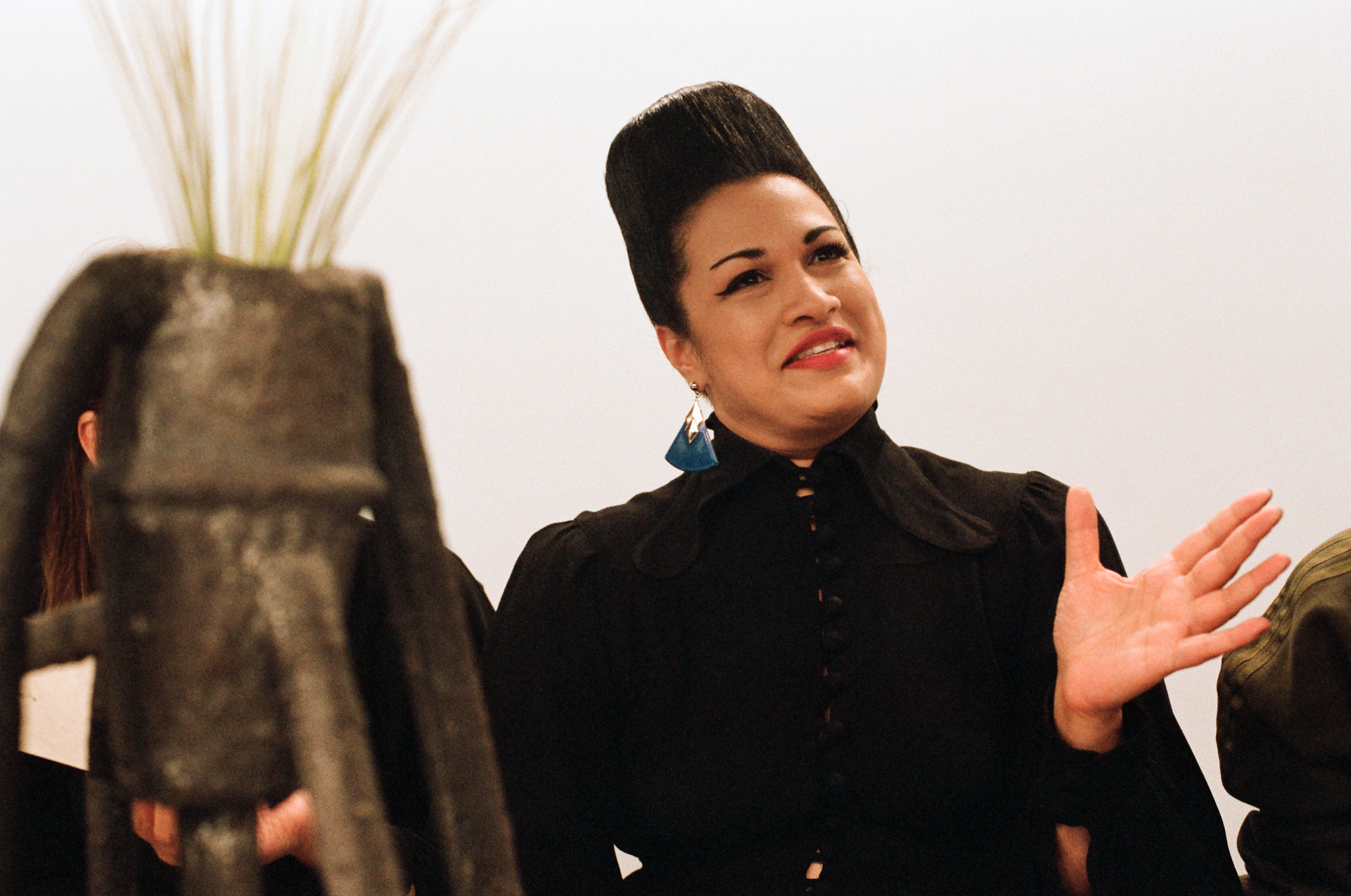
The lead photograph shows composer, producer and performer Bishi Bhattacharya at a Frieze seminar in London in 2016. It is historic context for the fair as a convening space, not Frieze London 2026, TAFETA’s TEFAF presentation, a current acquisition, a nominated artist or a current programme. Photograph by Steve Bowbrick, CC BY-SA 2.0.