> **Cartagena, Ouagadougou and Busan show that a festival becomes public through where it travels, who can shape it and whether looking leads to learning, making or return. London is one route among many.**
A festival is very good at giving us a first image: a carpet, a flash, a crowd gathering outside a single screen. The image has its own charge. It is not the whole public life of an event.
The risk is not merely that the image is partial. It is that London can begin to look like the measure by which other cultural routes are judged: the metropolitan premiere as centre, everything else as outreach. That hierarchy is not very useful. The more interesting question is simpler and more demanding: where does a festival travel, who gets a say in its shape, and what is made possible beyond the screening?
The 70th BFI London Film Festival runs from 7 to 18 October 2026. BFI describes an encounter across London, partner cinemas around the UK and BFI Player. It also names free events, Screen Talks, LFF Expanded and specific access provisions, including descriptive subtitles, audio description, Relaxed screenings, BSL-interpreted and live-captioned events.1 2 These are real routes. But they should be read as routes, rather than folded into a general claim that an international festival is automatically public.
Cartagena offers one useful comparison. At FICCI 64 in 2025, Cine en los Barrios opened in Parque Espíritu del Manglar and travelled through named Cartagena neighbourhoods, including Nelson Mandela, Nuevo Paraíso, Torices, Villa Corelca and Blas de Lezo. Colombia’s Ministry of Cultures recorded more than 50 outdoor screenings across the city. The same festival programme included conversations, workshops and encounters around community and Indigenous cinema.3
What matters is not a romantic image of cinema arriving in a neighbourhood. FICCI changes both the site of exhibition and the social role of its audience. A screen in a public space is joined to local conversation and learning. The festival is not simply made more visible; it becomes a civic occasion with particular places, terms and people attached to it.
FESPACO’s 2025 Hors Les Murs route gives the question another form. Supported by UNICEF and delivered through Cinéma Numérique Ambulant, it took film screenings to peripheral Ouagadougou neighbourhoods and to named towns including Koudougou, Kombissiri, Zorgho, Boussé, Yako and Pabré. Alongside it, FESPACO Sukabe placed children in screenings and film learning: UNICEF records 200 children in tale-writing and 30 children trained across writing, image, sound, casting, production and direction before presenting their own film publicly.4
This is not evidence that every FESPACO edition, or every audience, is equally served. It is evidence of a defined 2025 mechanism: a mobile route, named places and a path from viewing to making. That distinction matters. A festival’s public language becomes credible when it can point to the infrastructure that carries it.
Busan offers a third mechanism: decision rights. For its announced 2026 Community BIFF programme, the festival invited proposals from filmgoers and combined a public vote of 5,035 participants with expert review to select 18 programmes. It locates the programme in Nampo-dong through outdoor events, free outdoor screenings, discussion and citizen-made short films. Its announced schedule also includes a barrier-free screening with subtitles and audio commentary.5
Community BIFF is not an uncomplicated model of audience rule. Voting sits alongside expert selection, and entry still depends on the structures of proposal, venue and capacity. That is precisely why it is useful. It makes the terms of participation visible. The public is not merely invited to arrive; it is given a bounded part in shaping the event.
These examples do not form a league table. Each belongs to a particular place, funding structure and history. They do, however, clarify a question for London. The question is not whether the BFI London Film Festival is already open. It is which routes it chooses to make durable, legible and accountable.
There are three routes worth asking after. The first is a repeatable neighbourhood-facing screen programme beyond the usual festival footprint, made with named local partners rather than added as a symbolic extra. The second is a defined public programming route: a commission, proposal call or citizen jury that gives audiences visible influence while retaining curatorial responsibility. The third is a year-round making route, connecting viewing to schools, community groups, emerging critics or young filmmakers before and after the festival dates.
The BFI already identifies several routes: London venues, partner cinemas, BFI Player, free events and access information. The comparators do not disprove those provisions. They sharpen the next question: which routes are temporary, which are local, which give the public agency, and which leave something behind?
Use the Festival Route: Room, Region, Relay, Access and Agency. Room asks where the work is encountered. Region asks which places beyond the centre receive it. Relay asks what travels through a player, archive or conversation. Access asks which conditions are stated rather than assumed. Agency asks whether people can do more than attend: can they shape, discuss or make something?
A festival does not become public merely because it is international, free in one place or visible on a red carpet. It becomes public through its routes: named locations, terms of entry, partners, decision rights and the work that continues when the lights come up.
References
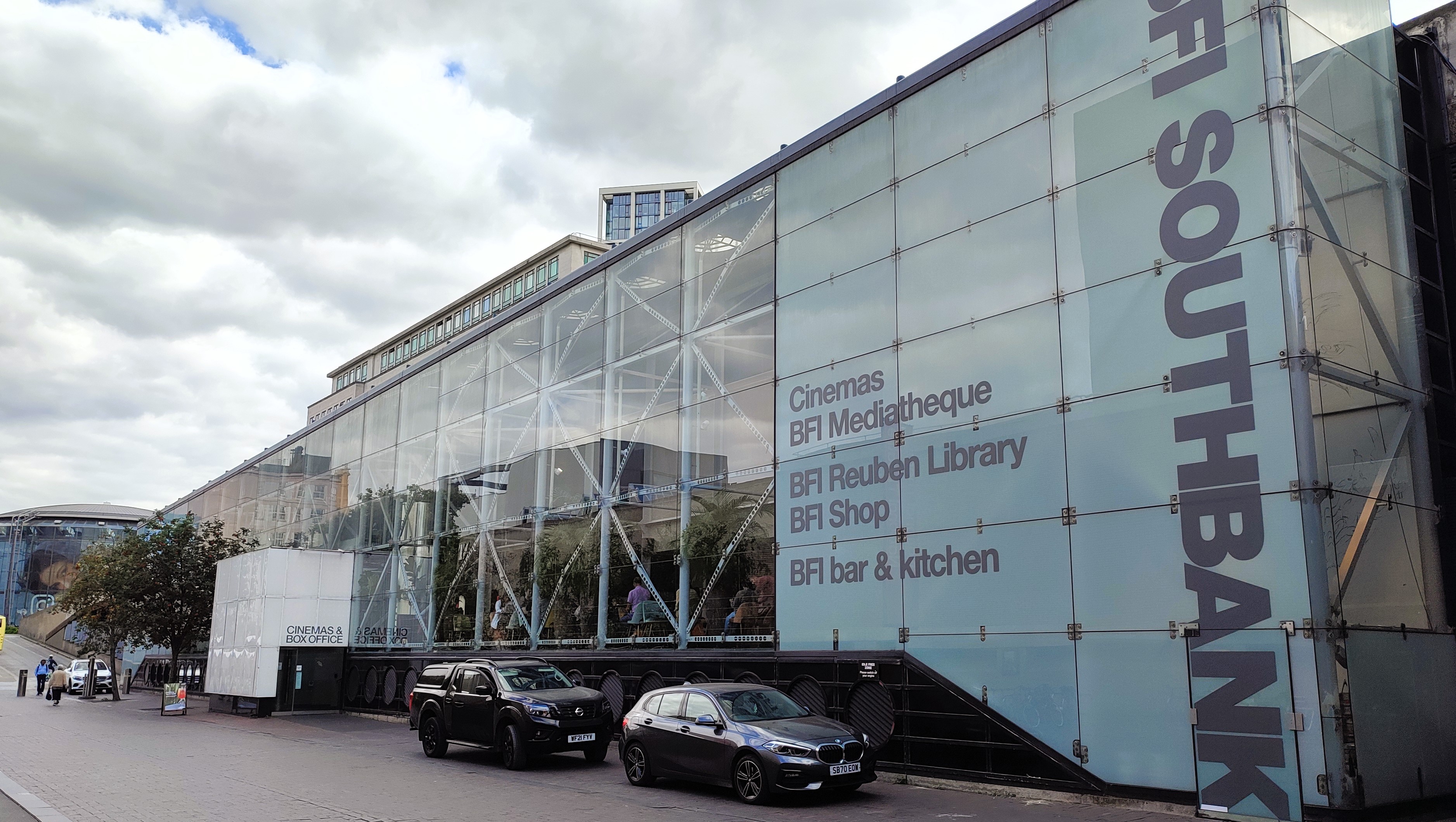
Lead image: BFI Southbank exterior, 2025, Ewan Munro, CC BY-SA 4.0, via Wikimedia Commons. Documentary location context only; it does not depict the 2026 London Film Festival, its programme, artists or audiences.