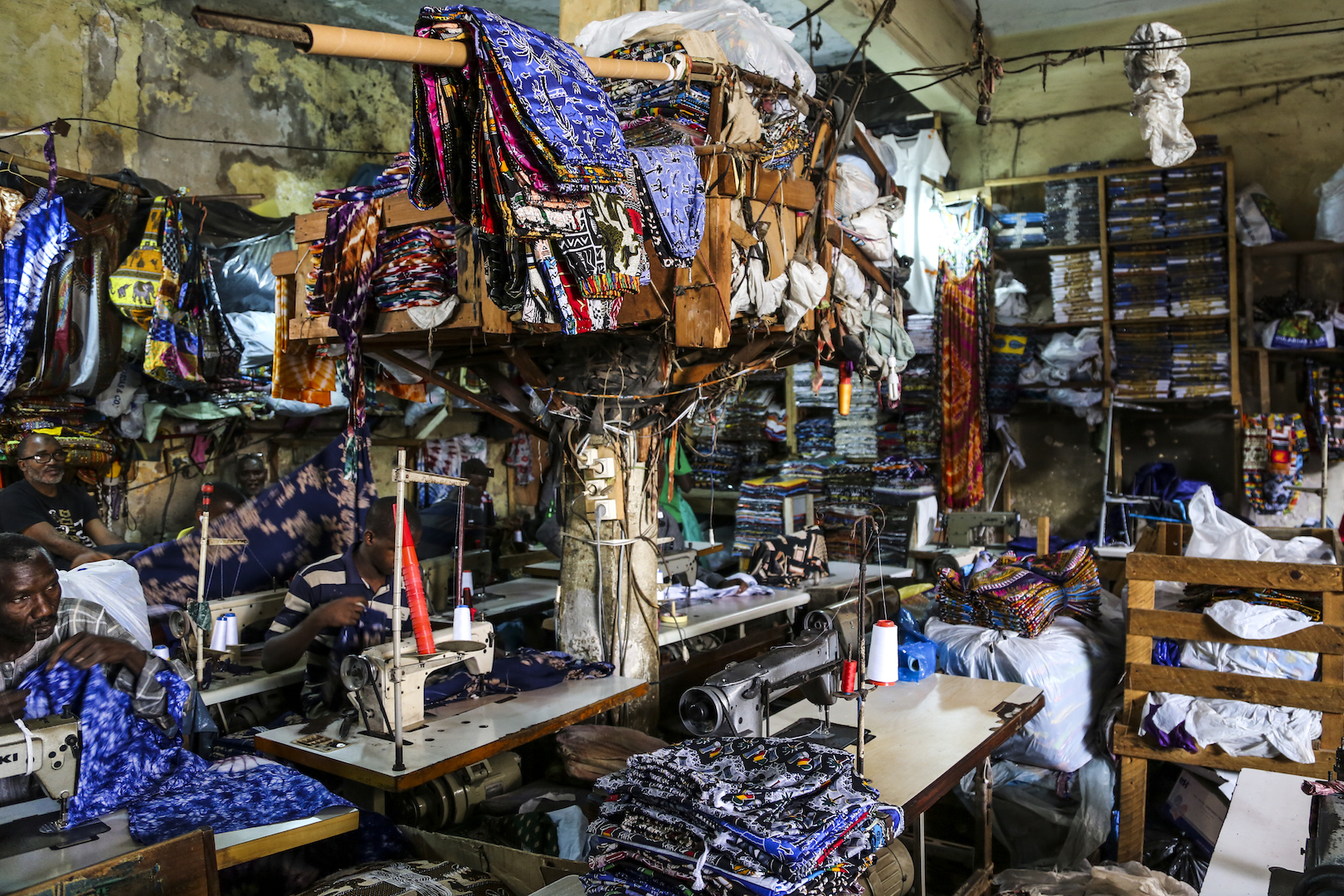
Lead image: a working tailoring atelier in Medina, Dakar, Senegal, photographed by Julien saison in 2016. This documented production-context image does not depict London Fashion Week or BFC NEWGEN. Julien saison, “Atelier de couture, Medina, Dakar, Sénégal” (2016), CC BY-SA 4.0, via Wikimedia Commons.
The photograph is the most efficient instrument in fashion. A show begins, a silhouette appears, an image moves at the speed of appetite. By the time the collection is discussed, the conditions that allowed it to exist have often slipped out of view.
That is the weakness of treating fashion week as a sequence of first looks. The first look matters. It gives a designer a public claim. But a first view is not first support. A calendar slot, a front-row invitation and a public encounter are different forms of visibility; none, alone, tells us whether a practice has the material room to return next season.
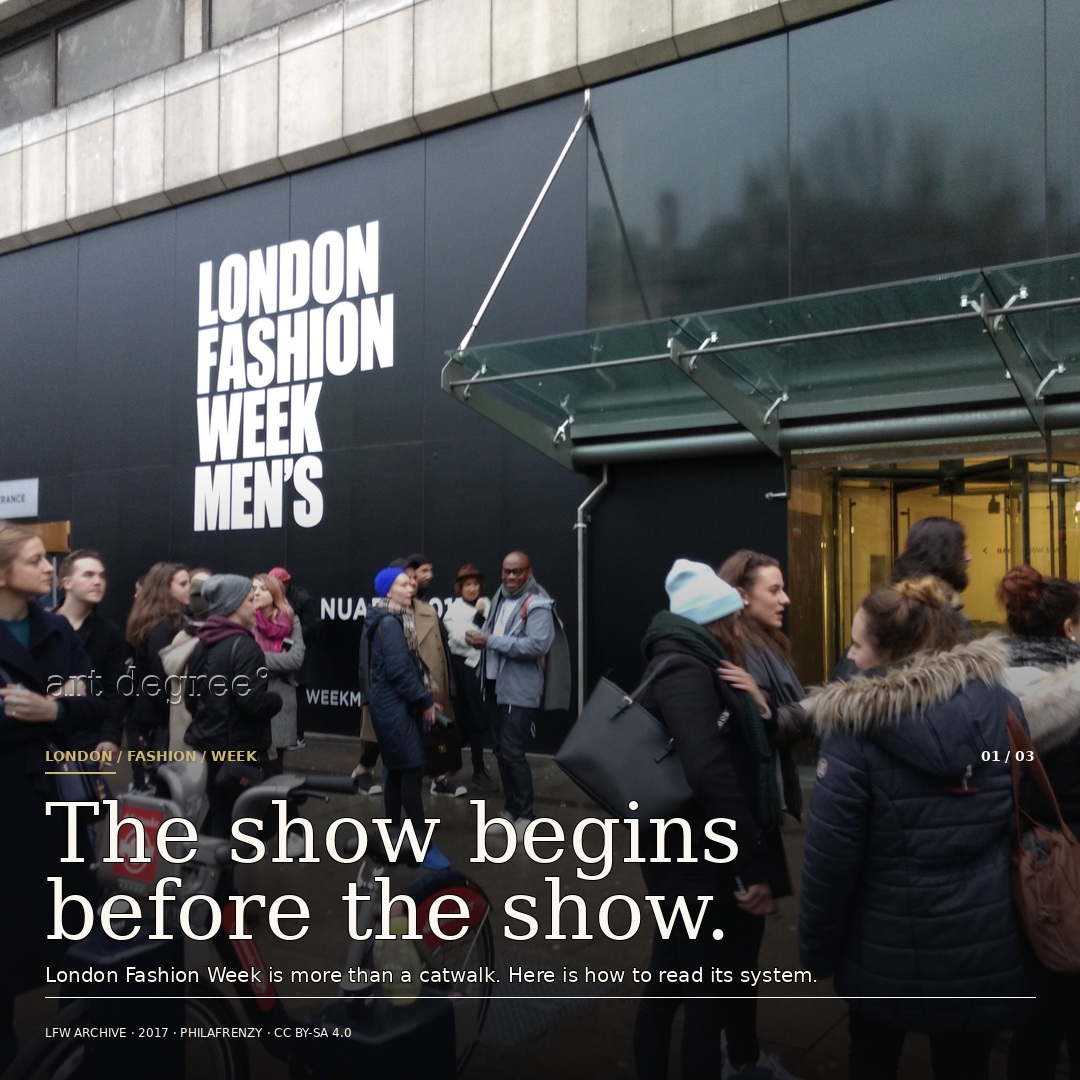
London Fashion Week’s Friday schedule makes that distinction unusually clear. Much of the daytime programme is marked invite only: catwalks, presentations and appointments with their own professional boundaries. Two encounters are explicitly marked open to public: Saul Nash AW26 Masquerade in Residence, listed from 10:00 to 19:00, and the BFC Jewellery Showcase at Dover Street Market, listed from 11:00 to 19:00. London Fashion Week’s Citywide programme also lists two Moleskine activities at Battersea Power Station. 1 3
The point is not to make these rooms compete. A public pop-up, a buyers’ appointment, a showcase in a shop and a catwalk for invited guests all serve different purposes. The point is to notice that access is neither singular nor self-explanatory. A door can be open without offering continuity. A show can be closed without being culturally insignificant. What matters is the system around the entry point.
The British Fashion Council’s NEWGEN programme makes some of that system legible. It describes an initiative for emerging design talent built around grant funding for showcasing and bespoke business mentoring. For its 2026/27 recipients, the BFC says the support can include a financial bursary, a digital or physical London Fashion Week schedule slot and average value-in-kind showing support of approximately £80,000 per recipient. The stated provision includes waived listing fees, a producer and production team, basic lighting, seating, sound, security and BFC venue space subject to availability. 2
The figure is not the argument, and it should not be romanticised. It is value in kind, not a uniform cash payment. The bursary is partial and conditional. The BFC does not state that every recipient receives every support element on identical terms, and the support does not guarantee sales, critical attention or a durable business. Yet that is precisely why the programme is useful to read closely. It describes a real architecture of assistance: not only a moment on a schedule, but production labour, advisory time, legal counsel, business structure and a possible route to international press and buyers through the BFC’s seasonal Paris showroom. 2
What disappears from a fashion image is often what makes the image possible. A producer absorbs a pressure that never reaches the caption. A venue cost is waived. A lawyer takes a call. A buyer sees a collection in a showroom rather than through a compressed clip. A mentor knows a manufacturer. These conditions are not decorative background to talent. They are part of how talent becomes a practice.
Friday’s programme gives the argument a concrete frame without asking us to invent outcomes. E.W.USIE appears as a NEWGEN appointment. Oscar Ouyang and A LETTER are listed at the NEWGEN Catwalk Space. The Ouze is listed in the NEWGEN Presentation Space. Petra Fagerström appears in the Friday catwalk programme and is named by the BFC as a new recipient for 2026/27. 1 2 These are programme records, not a verdict on the work or a forecast of their futures. They are enough to ask a more exact question: what is being made available before the photograph has to carry everything on its own?
The answer can be carried from London to any fashion city without assuming that one system stands in for another. The Dakar atelier above is not an illustration of NEWGEN. It is a specific documented working environment in a different city, economy and set of relationships. It is included because it makes production visible as a lived infrastructure of material, labour, machines, storage and skill. It should not be used to turn African work into generic texture for a London argument. Its relevance is the opposite: fashion’s enabling conditions are always local, practical and culturally situated. 4
That is why a useful fashion-week reading needs a compact test.
The Return Test
| Ask | What it helps reveal |
|---|---|
| Room | Who can encounter the work, and under which stated terms? |
| Resource | Which funding, labour, material knowledge or institutional support enables it? |
| Route | How does the work travel to an audience, buyer, press or public? |
| Return | What conditions could allow the practice to be seen, revised and paid again? |
The test does not turn culture into a scorecard. It slows the eye down. It asks the reader to see a fashion image as the visible point in a longer chain, without assuming that the chain is fair or complete.
This is not a demand that every fashion week become a public utility. Nor is it a claim that infrastructure can resolve the industry’s contradictions. It is an argument for better attention. The runway is a first view. The conditions of a second season are the fuller story.