Fashion week is often described as a schedule: catwalks, presentations, appointments and after-parties arranged with military precision. But a schedule is only the visible edge of the thing. Before a collection makes its official claim, a city has already begun distributing attention: through invitations and shop windows, queues and screen time, borrowed references and the less visible work that makes a show possible at all.
London Fashion Week runs from 17 to 21 September 2026. Its programme puts a Marks & Spencer “see now, buy now” collection, a Dover Street Market jewellery showcase, a Nick Knight and SHOWstudio collaboration with H&M, eBay’s pre-loved Endless Runway and Selfridges’ British-designer edit in the same city-wide frame.1 These are not interchangeable sideshows. They make fashion’s different rooms visible: retail, image-making, resale and the support systems behind a young label. The runway may still be the theatre, but the city is the machinery.
The front row is not the whole room
The question worth carrying through London is not simply who has the best show. It is who has been given a route into view. Retail activations may broaden the encounter with fashion, but access does not become equitable simply because a door is technically open. The useful distinction is between publicity and participation: who is seen, who is paid, who is able to return and whose work can continue after the photographs have moved on.
This is why the British Fashion Council’s NEWGEN programme matters. The BFC describes it as grant funding, showcasing and tailored mentoring for emerging designers, including support across finance, business structure, manufacturing, sustainability and legal counsel. Its showing support includes a schedule slot, production assistance and, on average, around £80,000 in value-in-kind per recipient.2
Talent may be the part we remember. Infrastructure is the part that allows talent to survive long enough to become a practice.
London is a room, not the whole house
London is a useful lead because it makes several systems share one timetable. It is not the only model worth reading. Elsewhere, the same questions take different forms — not as a competition between cities, and not as a claim that any one week can stand in for a whole place, but as a way to make infrastructure visible.
In Tokyo, the Japan Fashion Week Organization joins a Fashion Week Division to a Textile Division and says it works across manufacturers, designers and distributors.3 The question there sharpens around Resource and Route: what changes when a fashion week is attached to material knowledge and distribution, rather than treating a collection as a self-contained image?
In Shanghai, the official fashion-week trade-fair page describes MODE and its connected showroom platforms as an order-season network carrying brands into differentiated markets.4 That makes Route tangible. The image is not the end of the fashion-week story; trade infrastructure is another way a collection becomes a future season.
Dakar Fashion Week describes its role as a platform through which African designers present work to the global market, while foregrounding African savoir-faire and craft.5 It makes the questions of Room and Resource inseparable: who authors the terms through which skill becomes visible, and who gets to carry that visibility outward?
In Lagos, Style House Files names itself a fashion business-development agency and places Lagos Fashion Week inside a wider set of fashion-facing projects.6 The useful question is not whether a city has “arrived” on someone else’s calendar. It is what kinds of business infrastructure allow fashion practice to build continuity from within its own field.
These are not interchangeable examples. They are four different prompts for reading the systems around a collection. London’s value is not that it has the final word; it is that this week offers a clear place to begin asking better questions.
The second life is part of the first image
eBay’s return with a pre-loved runway is a small but pointed programme fact. It places resale in fashion week’s visual economy rather than waiting for it to appear years later as a private act of repair or thrift.1
That does not make circulation innocent. A pre-loved garment may still contain difficult histories of labour, price and access. But it gives the reader a better question than “is it new?”: what kind of life is this object being designed to have after its first owner?
Image is a form of production
H&M’s collaboration with Nick Knight and SHOWstudio draws attention to another hidden room: the one where clothes become images. The fashion image is never simply a record of a garment. It decides what counts as desirable, who receives the authority to interpret a silhouette and how quickly an idea can travel.1
The show begins before the show because fashion’s first public is already making an edit of its own.
The Fashion Week Index
| Ask | What to look for |
|---|---|
| Room | Who can encounter the work beyond an invitation-only seat? |
| Resource | What funding, production, material knowledge, mentoring or legal support makes it possible? |
| Route | How do clothes and ideas move through retail, media, trade and resale? |
| Return | What remains after the images: a garment’s later lives, a designer’s continuation, an audience’s reference? |
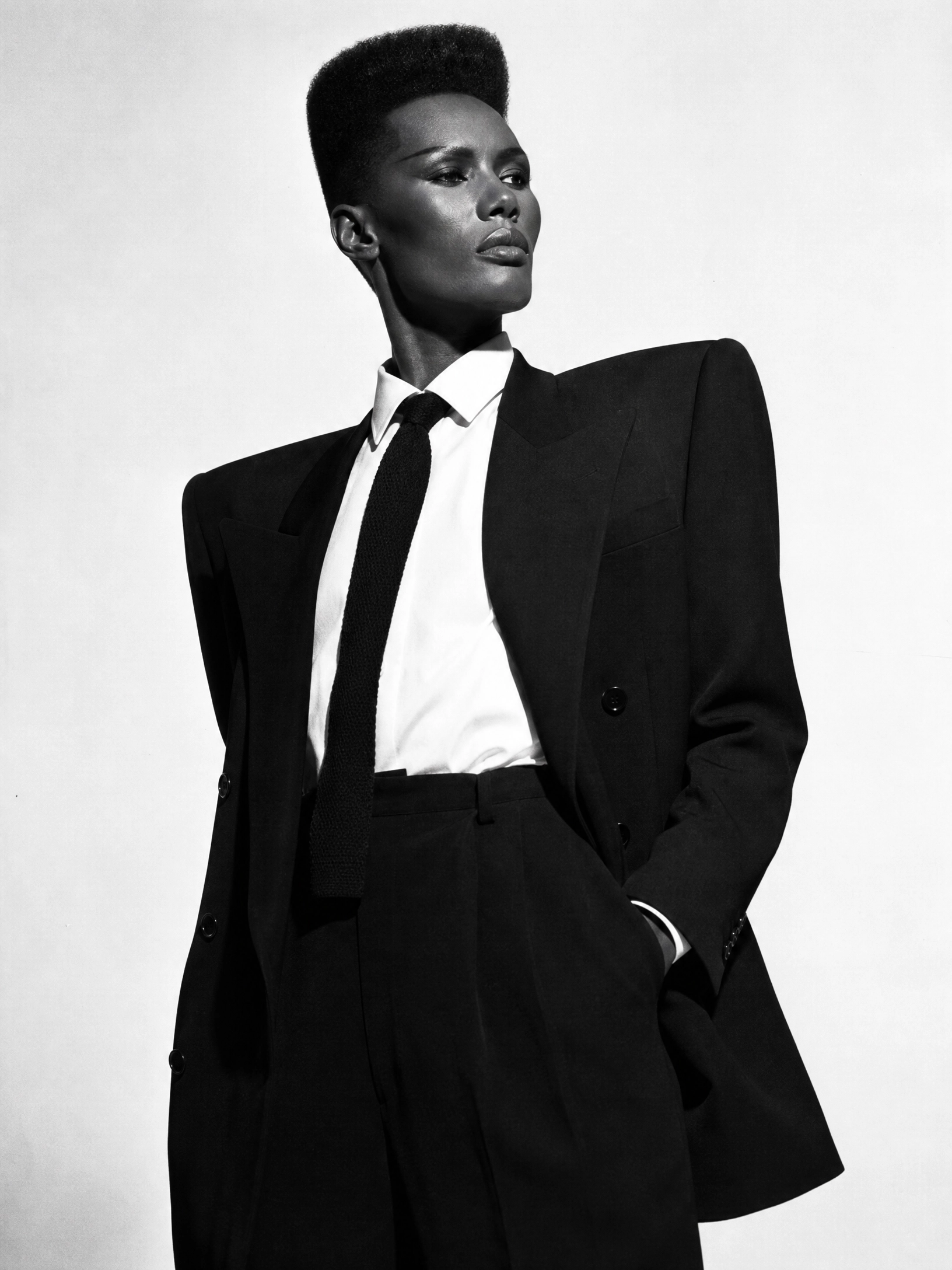
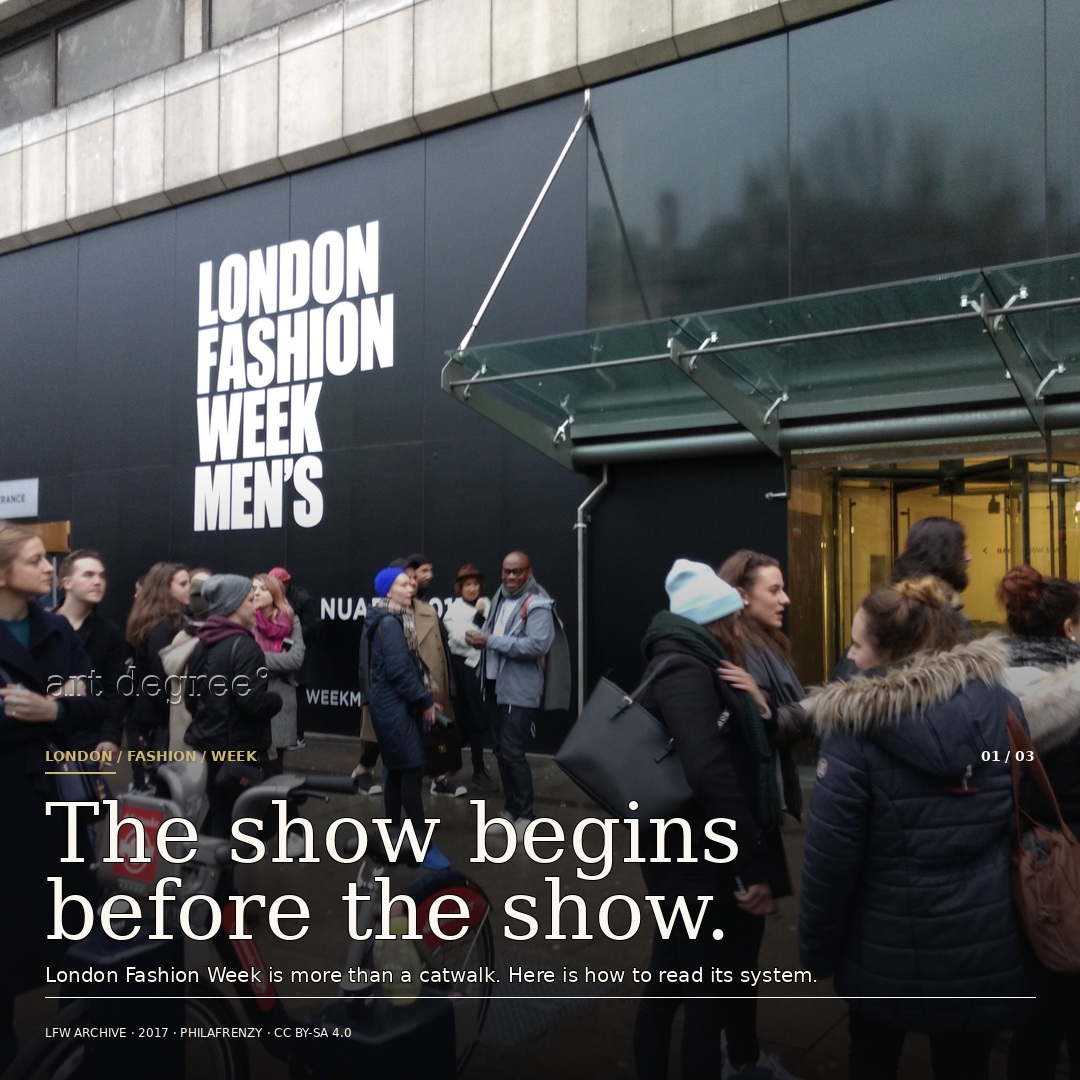
The archive record of London Fashion Week Men’s in 2017 is useful precisely because it is not current. It holds an earlier moment in which the same mechanics are visible: the venue as a sign, the wait as a performance, the person passing through as an edit. The images do not tell us what this September will look like. They tell us that fashion week has always started before the lights go down.
The best work of the week will not merely give London something new to look at. It will make clearer how a collection arrives, who helps it arrive and what kind of public life it can have afterwards.
Reader links
Lead visual and gallery: documented London Fashion Week Men’s archive context, January 2017, Philafrenzy, CC BY-SA 4.0. The images do not depict the September 2026 edition.