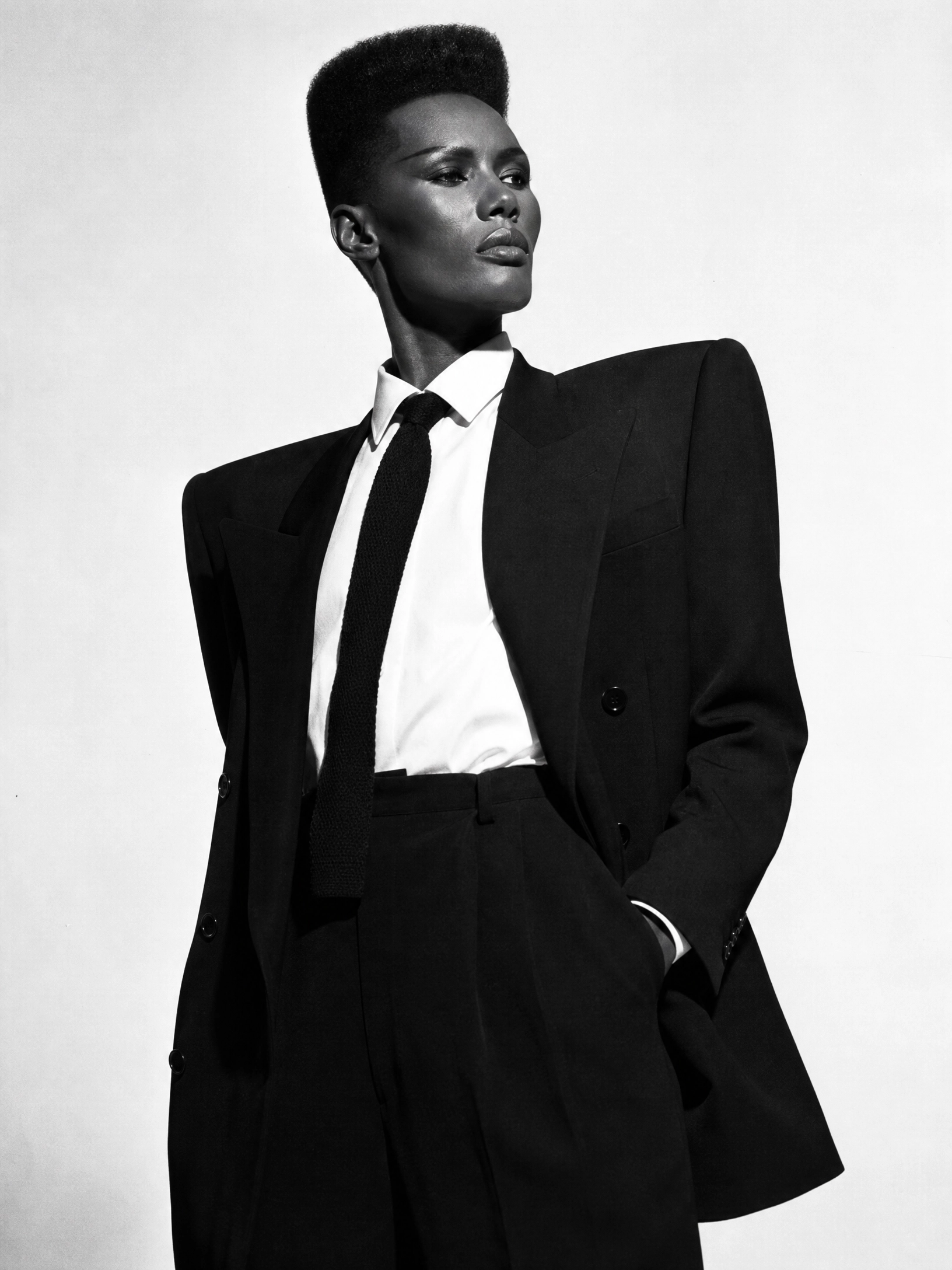
There is a photograph from 1975 taken in Paris. It shows a young model, recently arrived from New York. She is inspired by Wifredo Lam. She wears a white cutaway blazer, shoulders squared to the camera, a black knit tie, slightly askew. Her name is Grace Jones.
Three years later, she has begun to erase this part of her life. She is a Jamaican performer, of flesh, provocation, and velocity. Stuart Hall will call her method a 'politics of representation'; bell hooks, a 'radical black subjectivity.' Nightclubbing (1981) shows a figure with half a face — the other half painted, powdered, and armoured. A large stripped canvas forms the background, only obstructed by the geometry of Jean-Paul Goude's lens. But at the bottom of every image is the same architectural silhouette. And on the figure: a black suit, a white collar, a black tie.
The stylist and cultural critic André Leon Talley recalled: 'Bethann Hardison was always going on about what a Black woman could do with a shoulder. Well, Grace had thought about all of that long before anyone had, I'm sure. Tried it out. Seen what worked.'
With her first modelling jobs in New York's Wilhelmina agency, Jones developed a style, and a uniform. A structured blazer, an unbuttoned tailored shirt, a black knit tie. Less formal, a bodysuit — black and severe or white and architectural — always with its geometry intact. A cropped leather jacket. A cape with shoulder-straps. To the photographer Helmut Newton, she declared wanting to 'look inhuman, but better than human.' On her feet, for many years, flat boots. She had grown up in the Jamaican countryside, in Spanishtown, under the strict authority of a Pentecostal grandfather.
As success came, she added armour — first to her collaborators' photographs, then to her body: flat and golden in Goude's compositions at first; a Thierry Mugler suit of structured wool soon after. Evenings meant Studio 54 which meant leather: soft and tight, with a cashmere turtleneck on bare skin and slim trousers. Soon, a bodysuit. Late, a vinyl bodysuit.
She performed in no fabric more than cotton, adding sweat to the performance. 'I always think of myself not so much as a performer but as a medium for transformation.' In 1981, the year of Nightclubbing — a self-portrait in a dark single-breasted suit and flat black boots — Azzedine Alaïa began making clothes for her body specifically, cutting patterns from her measurements alone.
Even then, double-breasted suits — especially those cut by Mugler and Alaïa — were kept for performances in France. In the 1980s, she had her collaborator's Comme des Garçons jacket copied, but never wore it. In 1982, she commissioned a suit from Issey Miyake. In the last two decades of her performing life, the suits lost their padding; the shirts, their collars.
With her later performances, the 60-year-old artist played dress-up with the audience, matching herself against the stage in dark suits and 'shiny black platform boots, which she shows off to the crowd with a smile as if she is sharing a private joke.'
The artist Jean-Michel Basquiat declared: 'Grace Jones wore only a few looks but it was as if she had completely invented style — as though there was no such thing as style until she wore a flat-top and a Mugler suit.'
'I've always liked that about the French,' says Grace. 'They're much clearer about the body than the English.'