Art Basel Paris: The Grand Palais Becomes a Cathedral of Contemporary Art
Art Basel's second Parisian edition transformed the renovated Grand Palais into a breathtaking showcase, from Gerhard Richter's $23 million painting to Ruth Asawa's revolutionary wire sculptures.

A Statement Opening
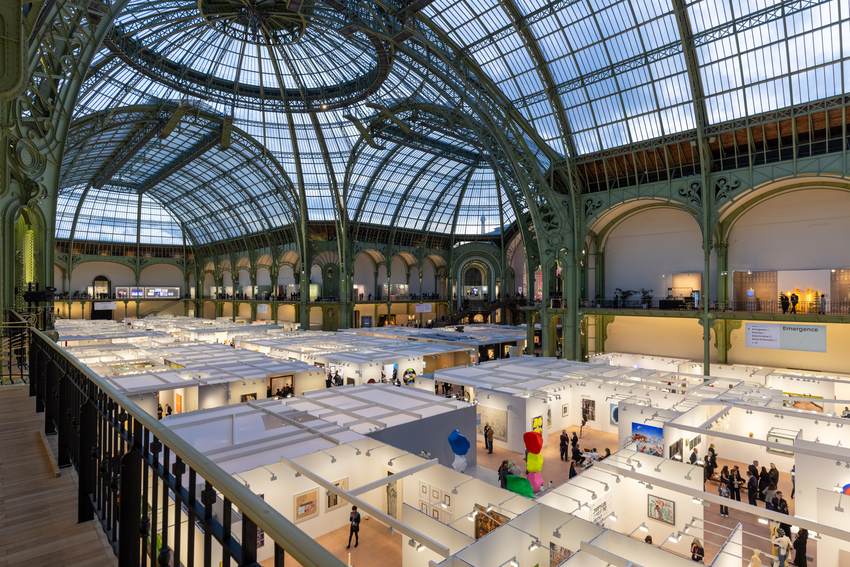
Under the iconic glass roof of the Grand Palais, Art Basel Paris established itself as more than just another art fair—it became a cultural event that placed Paris firmly back at the center of contemporary art conversation.
The fair opened with a statement sale: Gerhard Richter's monumental 1987 "Abstraktes Bild (Abstract Painting)" sold at Hauser & Wirth for $23 million. The painting—a dense, multi-layered field of crimson, teal, and charcoal-grey created with Richter's signature squeegee technique—demonstrated that masterworks by canonical artists still command extraordinary prices.
The timing was perfect: the sale coincided with the major Richter survey at Fondation Louis Vuitton, creating a cultural moment that extended beyond the fair itself.
Modern Masters
Pace Gallery anchored its presentation with Amedeo Modigliani's 1918 canvas "Jeune fille aux macarons," which sold on opening day for $10 million. The work exemplifies Modigliani's mature style—elongated neck, almond-shaped eyes, intimate yet mysterious intensity.
The painting's sale demonstrated continued appetite for early 20th-century modernism, particularly works with impeccable provenance and museum-quality execution.
Ruth Asawa: Drawing in Space
David Zwirner presented Ruth Asawa's stunning "Untitled (S. 278, Hanging Nine-Lobed, Single-Layered Continuous Form)," circa 1955. Standing nearly ten feet tall, the brass wire sculpture embodies Asawa's concept of "drawing in space"—a single continuous strand looped to create complex, biomorphic forms.
As Asawa said, "I'm not so interested in the expression of something. I'm more interested in what the material can do."
The sculpture's presence at Art Basel Paris reflected growing institutional recognition of Asawa's contribution to post-war American art. Her work—long overlooked during her lifetime—has been the subject of major museum retrospectives and commands increasingly significant prices at auction.
Cross-Century Conversations
In a bold curatorial move, Gagosian secured special exemption to present Peter Paul Rubens's 17th-century "The Virgin and Christ Child," exhibited in dialogue with works by John Currin, Jadé Fadojutimi, Alberto Giacometti, Pablo Picasso, and Jenny Saville.
The juxtaposition created unexpected resonances: Rubens's baroque flesh tones echoed in Saville's monumental nudes, his compositional drama reappeared in Currin's unsettling domesticity. The presentation demonstrated that historical works, when placed in contemporary context, reveal new meanings.
The Grand Palais Effect
The venue itself became part of the narrative. The Grand Palais—recently renovated after years of closure—provided a cathedral-like setting that elevated the fair beyond typical convention center aesthetics. Natural light flooded through the iconic glass roof, transforming the viewing experience.
Galleries responded to the architecture, creating presentations that emphasized scale and drama. The space demanded ambition, and exhibitors delivered.
Market Signals
Beyond individual sales, Art Basel Paris demonstrated that the contemporary art market, after a period of uncertainty, has found its footing. Collectors showed appetite for museum-quality works across price points, from emerging artists to established masters.
The fair's success also validated Paris's renewed position in the global art circuit. After years of ceding ground to London, New York, and Asian art hubs, Paris has reasserted its cultural authority.
Looking Forward
Art Basel Paris proved that the city's cultural renaissance is real. The combination of renovated institutions (Grand Palais, Bourse de Commerce), major private collections opening to the public (Pinault, Arnault), and renewed gallery activity has created momentum.
The fair's second edition exceeded expectations, suggesting that Art Basel Paris will become a permanent fixture on the global art calendar—not as a secondary market to Basel or Miami, but as a distinct cultural event that leverages Paris's unique position at the intersection of historical prestige and contemporary ambition.
For collectors, dealers, and institutions, the message was clear: Paris is back, and Art Basel Paris is the platform that announced its return.